Construction projects today involve multi-layered systems, tight MEP corridors, prefabricated components, and complex structural cores, all coordinated within compressed timelines. In this environment, misalignment between design and execution can lead to major cost and time overruns. As global infrastructure becomes more regulated and risk-sensitive, AEC firms must shift toward data-centric delivery models that offer transparency, traceability, and lifecycle control from day one with structured BIM implementation support.
BIM has evolved from a modeling tool to a contractual requirement in many regions. Standards like ISO 19650, PAS 1192, and frameworks under the UK BIM Mandate now define how digital construction data must be structured, exchanged, and maintained across disciplines and project phases. Public and private clients increasingly demand BIM deliverables aligned with global funding conditions and FM-ready outputs like COBie or IFC4-based asset data. The result: BIM is no longer optional; it’s critical for compliance, competitiveness, and operational efficiency.
MaRS BIM Solutions bridges the implementation gap for firms navigating this shift. Rather than offering off-the-shelf services, MaRS delivers project-specific BIM strategies that align with contractual scopes, delivery models like Design-Build, IPD, PPP, and downstream data use. With deep technical knowledge across verticals like healthcare, industrial, and infrastructure, MaRS enables teams to operationalize BIM standards through structured execution plans, intelligent models, and smooth coordination environments.
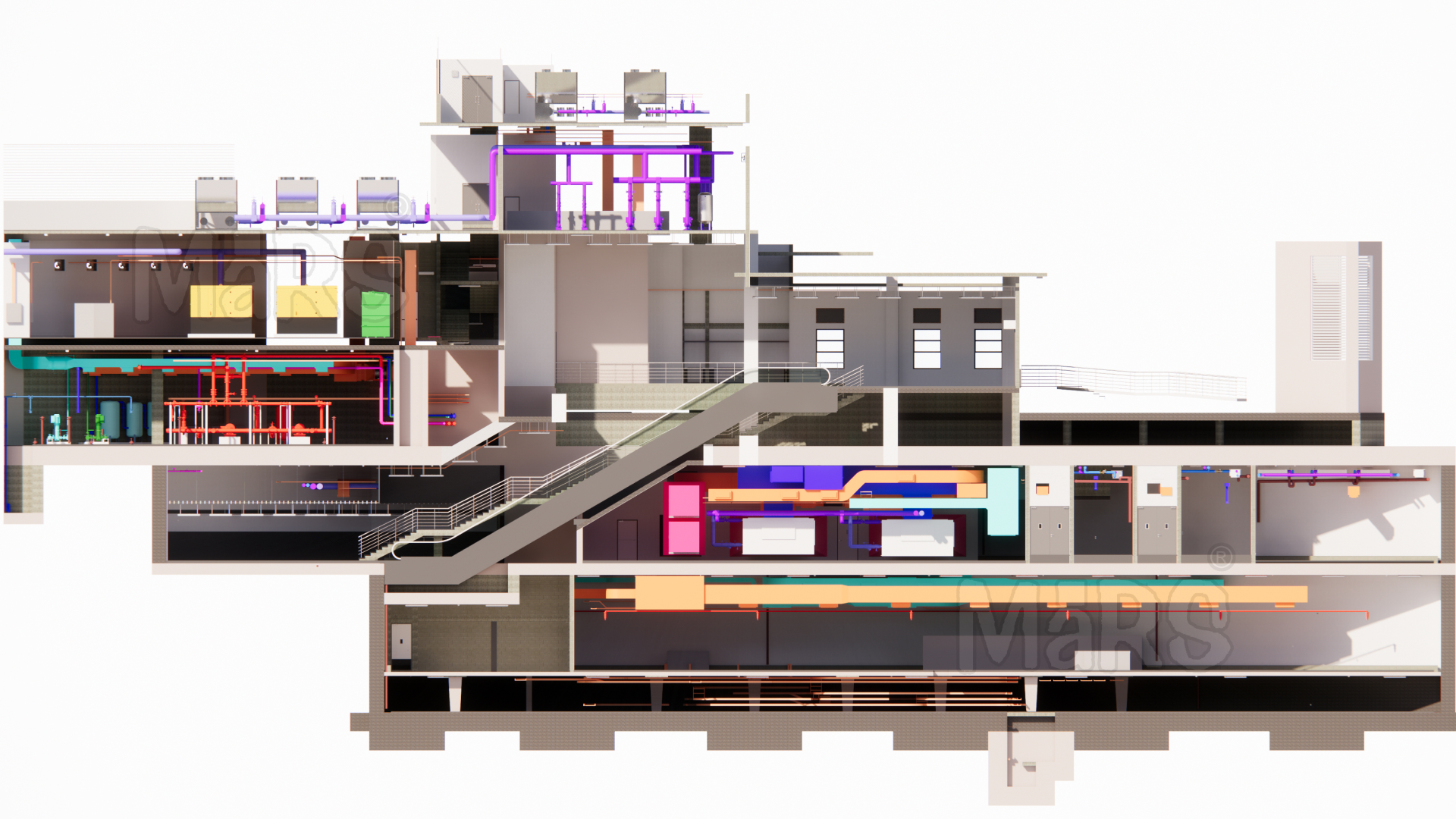
Why Expert BIM Consulting & Implementation Support Matters
Most AEC projects face delays and rework because of poor data integration, misaligned design intent, and manual coordination between disciplines. Without structured BIM implementation support, models often become fragmented, clash-heavy, or unusable for downstream tasks like quantity takeoff, construction sequencing, or asset handover. Firms adopting BIM without technical support frequently struggle with defining modeling standards, aligning LOD across trades, or producing deliverables that meet owner/operator requirements such as COBie or IFC4.
MaRS BIM Solutions addresses these gaps by engineering BIM workflows around project-specific outcomes, whether it’s integrating 5D cost data into Synchro schedules, preparing FM-ready data drops, or managing federated models across multiple consultants. Our team sets up BEPs, enforces parameter consistency across authoring platforms, and embeds review protocols that reduce RFIs and field issues. This structured implementation ensures that BIM becomes a performance driver, not just a compliance checkbox.
Key Challenges in BIM Adoption Across AEC
Loss of Data Fidelity in IFC Exchanges
IFC exports often strip critical data like shared parameters, classification codes, or nested families, causing compliance failures during asset data handover or facility management integration.
Discipline-Specific Modeling Inconsistencies
Architectural and MEP teams may follow different modeling logics like room-based vs. system-based. Which leads to misalignment in coordination zones and incomplete spatial validation.
LOD Fragmentation Across Trade Packages
In multi-phase projects, subcontractors deliver models at mismatched development levels. MEP trades may stop at LOD 300 while the structure progresses to LOD 350, disrupting constructability reviews.
Incorrect or Incomplete Parameter Structuring
Custom parameters without shared schemas hinder automation of schedules, tagging, COBie export, and integration with 4D/5D platforms like Synchro or Primavera.
Insufficient Quality Control in Federated Models
Aggregated models often carry unresolved geometry conflicts, duplicated elements, or reference file issues, resulting in failed clash reports and inaccurate site coordination.
Contractual Ambiguity in Design-Build and PPP Workflows
Without clear definition of BIM scope, data ownership, and model versioning protocols, stakeholders often work in silos, leading to rework during design approvals or technical submissions.
Absence of Standardized Data Exchange Protocols
When BIM data flows between different tools without agreed classification systems, information becomes unstructured and non-actionable.
MaRS BIM Solutions Specialized Implementation Support
Every project demands a unique BIM approach; what works for a healthcare facility won’t suit a high-rise residential tower or metro station. MaRS BIM Solutions starts by identifying the specific gaps in a client’s modeling workflows, coordination logic, and delivery structure. We develop customized BIM Execution Plans, define LOD progression frameworks, and build trade-aligned modeling protocols that ensure models are constructible, clash-free, and data-rich. Our support includes everything from parameter standardization and QA/QC routines to spatial coordination zoning and data exchange validation.
We also deploy project-specific Revit templates embedded with shared parameters, custom family libraries, and QA scripts to enforce consistency across design teams. Our experts configure secure Common Data Environments and manage federated model workflows using platforms like Navisworks, Revizto, or BIM 360. Whether supporting early-stage coordination or late-phase asset handover, MaRS delivers models aligned with ISO 19650, COBie, and owner-specified FM datasets.
Implementation Support For:

Core BIM Services & Capabilities
BIM Strategy & Planning
Development of BIM Execution Plans, Employer Information Requirements, and digital adoption roadmaps aligned to project goals and delivery models.
Custom Revit Template Development
Creation of discipline-specific templates with embedded shared parameters, naming conventions, LOD tracking, and QA/QC controls.
3D BIM Modeling & Trade Coordination
Accurate architectural, structural, and MEP modeling with clash detection, element validation, and coordination workflows using Navisworks or Revizto.
4D & 5D BIM Integration
Linking of BIM models with scheduling and cost estimation tools for construction phasing and quantity forecasting.
Software & Platform Integration
Setup and deployment of Autodesk BIM 360, ACC, Bluebeam, BIM Track, and other cloud-based collaboration environments.
Remote & On-Site BIM Staffing
Placement of BIM modelers, coordinators, and VDC engineers on flexible engagement terms to meet project phase requirements.
Model Auditing & QA/QC Services
Technical audits for model accuracy, parameter integrity, LOD compliance, and interdisciplinary alignment across federated models.
FM-Ready Model Development
COBie-compliant asset modeling, IFC4 data structuring, and structured datasets for facility operations and digital twin environments.
Training & Enablement
Project-based training programs, offshore knowledge transfer, AR/VR-integrated BIM navigation, and upskilling sessions tailored to client platforms.
Enhancing Execution On-Site & Offshore BIM Support
Construction-phase BIM support demands more than model viewing it requires active integration with lookahead schedules, method statements, and trade sequencing. MaRS BIM Solutions provides on-site coordination teams that work directly with construction managers, enabling rapid model validation before installation. Our teams conduct clash reruns aligned to field layout zones, generate LOD 400+ spool sets for MEP trades, and integrate model changes into 4D simulations for crane logistics, slab casting sequences, and vertical core planning. These outputs help eliminate costly field errors and accelerate workfront readiness.
For high-volume or multi-location projects, we deploy dedicated offshore BIM cells that manage package-level updates, produce construction-stage Revit models linked to WBS codes, and maintain real-time coordination with the on-site team. Tasks are split by scope, like floor-wise model updates, system-wise interference checks, tracked through defined issue logs, and delivered via secure CDE platforms. This hybrid model enables clients to achieve round-the-clock progress, reduce dependency on local manpower, and ensure that execution models remain aligned with procurement, fabrication, and site sequencing plans.
Sustainability & Future-Readiness
MaRS BIM Solutions integrates sustainability into the core of BIM workflows by allowing detailed material estimation, energy modeling, and construction phasing that minimizes waste and environmental impact. Our teams build models compatible with energy analysis tools to support LEED, IGBC, and other green certification processes, while also incorporating renewable system layouts, daylight simulations, and HVAC zoning for optimized performance. We help clients forecast carbon impact, reduce resource consumption, and plan for net-zero outcomes by aligning 4D and 5D data with sustainability goals. We structure BIM data for future-ready integrations supporting smart sensors, digital twins, and FM platforms that enable predictive maintenance, asset tracking, and lifecycle monitoring well beyond handover.
Measurable Results & Value Drivers
- 35% fewer RFIs through coordinated BIM models
- 50% faster MEP clash resolution with rule-based workflows
- 100% FM handover compliance
- Standardized BIM across multi-site projects
- Reduced rework and construction change orders
- Accurate 4D sequencing for phased execution
- Faster quantity takeoffs via 5D-ready models
- Improved asset performance post-handover
Engagement Process & Best Practices
Initial Consultation
We begin with a focused discussion to understand project scope, delivery model, and stakeholder roles, ensuring alignment on BIM expectations and pain points.
Needs Assessment
Our team audits current tools, modeling standards, and coordination workflows to identify capability gaps and integration challenges.
BEP & Roadmap Development
We prepare a detailed BIM Execution Plan, LOD matrix, data drops, and platform strategy based on client objectives and project stages.
Pilot Implementation
A small-scale BIM use case, such as a core area or trade package. It is executed to test workflows, validate templates, and optimize team alignment.
Team Mobilization
We deploy skilled BIM coordinators, modelers, or offshore teams as needed matched to project timelines and technical requirements.
Continuous Support
We provide regular model audits, clash detection cycles, parameter checks, and technical troubleshooting to maintain model quality.
Training & Enablement
Customized training ensures internal teams adopt standards, templates, and platforms with confidence both on-site and remotely.
Post-Project Review
We conduct a close-out review to evaluate performance, document lessons learned, and refine BIM strategies for future rollouts.
Conclusion
BIM adoption in AEC is now driven by data compliance, model accuracy, and lifecycle asset performance. Project owners expect delivery teams to align with ISO standards, maintain structured handover datasets, and enable smooth transition into operations. MaRS BIM Solutions provides the technical structure, platform integration, and trade coordination necessary to meet these requirements with confidence. From construction-focused modeling to FM-ready outputs, our implementation support helps firms standardize, scale, and deliver with precision.