
Requests for Information (RFIs) and change orders are two of the most costly and time-consuming problems a general contractor faces on any job site. In the United States, large commercial construction projects generate hundreds or sometimes even thousands of RFIs. According to studies by the Construction Industry Institute, rework alone accounts for approximately 5 to 15 percent of total project costs. Many of these problems trace back to a single root cause: incomplete, conflicting, or unclear design information before work begins.
BIM addresses this root cause directly. Through intelligent 3D modeling, clash detection, and coordinated documentation, BIM implementation gives general contractors a powerful toolset to identify and resolve conflicts before they reach the field, dramatically cutting the volume of RFIs, reducing change orders, and protecting project margins.
What Are RFIs and Change Orders and Why Do They Happen?
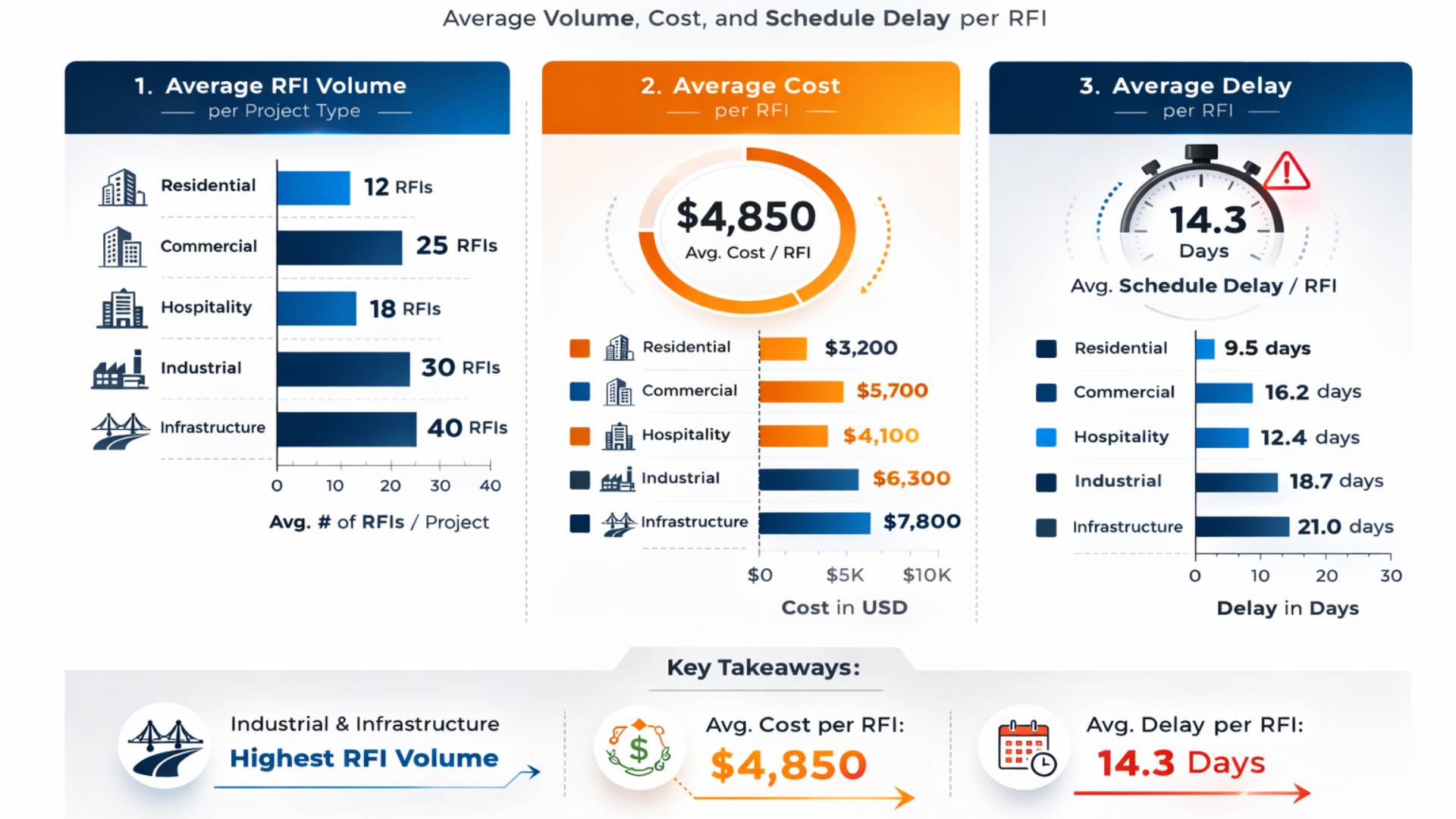
An RFI is a formal document issued by a contractor or subcontractor to the design team asking for clarification on drawings, specifications, or scope. A change order is an amendment to the contract that adjusts the scope, cost, or schedule. It is typically the downstream consequence of an unresolved design conflict or an unforeseen field condition.
The most common triggers include:
- Conflicts between architectural, structural, and MEP drawings that were developed in silos
- Missing dimensions or ambiguous details on construction documents
- Trade contractors discovering in the field that two systems physically can’t coexist in the same space
- Scope gaps between design disciplines that leave gray areas no one has taken responsibility for
Each RFI adds an average of 10 to 14 days of delay, according to research by Navigant Consulting. Multiply that across hundreds of RFIs and the ripple effects on schedule and cost become severe. Change orders compound the problem by requiring rebidding, re-procurement, and often, work demolition and rework.
How BIM Coordination for GCs Attacks RFIs at the Source
The core value proposition of BIM coordination for general contractors is simple: find problems in the model, not in the field. When architectural, structural, and MEP models are federated into a single coordinated model, every spatial conflict between building systems becomes visible on-screen before a single piece of pipe is hung or conduit is run.
Clash Detection: The Most Direct RFI-Reduction Tool
Clash detection and coordination is the process of running automated software checks, most commonly using tools such as Autodesk Navisworks that identify where elements from different models physically intersect or violate clearance requirements. Hard clashes (two objects occupying the same space) and soft clashes (insufficient clearance for maintenance access) are both flagged, logged, and resolved in coordination meetings before work is issued for construction.
A typical commercial project in the U.S. will generate thousands of initial clashes in the first federated model review. After coordination rounds, these are systematically resolved, and the construction documents are updated to reflect the coordinated design. The result: trade contractors receive a set of drawings that have already been checked for conflicts, so the need for field RFIs drops dramatically.
Industry Data Point: According to Autodesk, projects that implement BIM coordination report a reduction in RFIs of up to 40%, and some project teams report eliminating over 90% of coordination-related field conflicts before work begins.
Coordinated Construction Documents That Leave Less Room for Questions
BIM doesn’t just produce a 3D model, it produces data-rich, coordinated construction documents derived from that model. When drawing sheets are generated from a Revit model rather than drafted manually, dimensions, annotations, and details stay synchronized across all sheets. An update to the structural beam depth automatically propagates to every affected elevation, section, and detail.
This level of document coordination reduces the ambiguities that drive RFIs. General contractors relying on coordinated construction document support find that their trade contractors have fewer unanswered questions because the documents themselves are internally consistent.
MEP Coordination Services: Where Most RFIs Are Born
The mechanical, electrical, and plumbing trades are responsible for the majority of coordination-related RFIs on commercial construction projects. HVAC ductwork, pipe runs, conduit bundles, sprinkler systems, cable trays, and structural steel all compete for the same ceiling space. When design teams fail to coordinate with one another, conflicts become inevitable.
Professional MEP coordination services bring all of these trades into a unified coordination workflow. Each trade produces a Revit or CAD to BIM model of their systems, these models are federated, and then systematic clash detection and resolution rounds take place, usually in virtual design and construction (VDC) coordination meetings where representatives from each trade review and resolve conflicts together.
BIM for Electrical Contractors
Electrical systems are particularly prone to late-discovered conflicts because conduit, cable tray, and panel clearances are often not fully modeled in early design phases. BIM for electrical contractors transforms the process by requiring a detailed 3D model of the entire electrical distribution system before any on-site work begins. This model covers everything from the main switchgear to the branch circuits, ensuring full coordination in advance.
Through electrical modeling and coordination, GCs and electrical subcontractors can identify routing conflicts with mechanical ductwork, verify Code-compliant clearances around electrical panels, and confirm adequate space for future circuit additions all in the virtual environment. This eliminates a significant share of the RFIs that electrical contractors would otherwise generate during installation.
Mechanical and Plumbing Coordination
Similarly, mechanical modeling and coordination and plumbing modeling and coordination surface conflicts between ductwork, pipe systems, and structural members long before steel is erected. When a plumber discovers on-site that a drain line conflicts with a structural beam, the result is an RFI, a potential change order, and a work stoppage. When that same conflict is identified in the model at a coordination meeting six months earlier, the resolution is a 20-minute conversation and a model update.
BIM Benefits for General Contractors Beyond Clash Detection
Reducing RFIs through clash detection is the most cited BIM benefit for general contractors, but it’s far from the only one. The broader BIM workflow produces compounding benefits across the entire project delivery process.
4D Scheduling Reduces Schedule-Related Change Orders
A frequently overlooked category of change orders arises not from design conflicts but from sequencing errors. These issues occur when trade contractors arrive in the wrong order, leading to access conflicts or completed work that must be removed and redone. 4D scheduling links the BIM model to the project schedule, allowing GCs to visualize the construction sequence and identify sequencing conflicts before they cause field problems and the resulting change orders.
5D Estimating Reduces Cost Surprises
Change orders frequently arise because quantities were estimated incorrectly during procurement. 5D BIM estimating extracts quantities directly from the coordinated model, dramatically reducing the chance of quantity errors. When every structural member, pipe run, and conduit segment is modeled, the quantities are automatically embedded within the model and are not prone to manual takeoff errors.
Prefabrication Eliminates Field Variation

BIM-enabled prefabrication is one of the most powerful RFI-reduction strategies available to GCs today. When MEP systems are modeled in detail and that model is used to drive prefabricated MEP assemblies, the systems are fabricated in a controlled shop environment to exact dimensions and arrive on-site ready to install. There is almost no room for field interpretation — and therefore almost no occasion for an RFI.
Reducing Construction RFIs Using BIM: A Practical Workflow

For GCs looking to implement BIM as an RFI-reduction strategy on their projects, the workflow typically follows this sequence:
- BIM Execution Planning: Before design begins, the GC establishes BIM requirements, model deliverables, Level of Development (LOD) standards, and coordination protocols in a BIM Execution Plan (BEP).
- Design-Phase Coordination: Architectural, structural, and MEP models are developed in parallel and reviewed in regular clash detection sessions. Issues are resolved and documented in a clash log.
- Construction Document Issue: Coordinated documents are issued for construction. Because they derive from a coordinated model, they have fewer conflicts and ambiguities than traditionally drafted drawings.
- Construction-Phase BIM Support: The model is maintained and updated throughout construction as the GC tracks actual field conditions against the design model. Construction-phase BIM support keeps the model current and available as the go-to reference for all trades.
- As-Built Documentation: At project close-out, the coordinated model is updated to reflect as-built conditions. This process creates a valuable facility management asset for the building owner and completes the as-built modeling.
According to the BIM Forum, projects that implement structured BIM coordination workflows during the earliest design phases experience the greatest reductions in RFIs and change orders. This reinforces the idea that integrating BIM early in the project leads to a higher return on investment.
Real-World Impact: What GCs Are Seeing
The numbers behind BIM’s RFI-reduction impact are consistent across the U.S. construction industry. General Contractors working on hospital projects, which are among the most complex building types, report that clash detection sessions eliminate thousands of conflicts that would otherwise turn into field RFIs. On a typical 300,000-square-foot hospital in the southeastern United States, BIM coordination routinely resolves between 3,000 and 8,000 clashes before construction begins. At an average cost of $1,000 to $3,000 per RFI (including design review time, contractor coordination, and potential rework), the savings are in the millions.
On data center and laboratory projects, MEP systems are extremely dense and installation tolerances are tight. In these environments, BIM coordination has become a standard project requirement instead of an optional add-on. GCs who attempt to build these project types without BIM coordination routinely face change order rates that erode project margins entirely.
Key Takeaway: BIM coordination is not an overhead cost, it is a risk management investment. For every dollar spent on upfront BIM coordination, GCs consistently report saving between $5 and $10 in avoided RFI and change order costs downstream.
Choosing the Right BIM Coordination Partner
For general contractors who do not maintain in-house BIM departments, which represents the majority of small to mid-size contractors in the U.S., selecting the right BIM coordination services provider is critical. The right partner will have deep expertise in MEP coordination, clash detection workflows, Revit and Navisworks proficiency, and the ability to work within existing project team structures without creating additional coordination overhead.
Whether you need full-service MEP BIM coordination, structural coordination, or an integrated approach covering all disciplines, partnering with a dedicated BIM coordination team gives your project the upfront investment that pays dividends throughout construction. Explore the full range of BIM services to find the support your next project needs.
Conclusion
RFIs and change orders are not inevitable they are predictable, and they are preventable. The information gaps and coordination failures that generate most field problems are identifiable and resolvable in the virtual environment, given the right BIM coordination workflow. For U.S. general contractors under pressure to protect margins, maintain schedules, and deliver quality work, implementing BIM coordination is one of the highest-ROI decisions available.
The data is consistent, the technology is mature, and the adoption curve is steep: GCs who are not yet leveraging BIM coordination to reduce RFIs are leaving real money on the table and handing a competitive advantage to those who are.