Construction projects continue to grow in scale and complexity, requiring precise coordination between trades, tighter schedules, and greater accountability from all stakeholders. Successful delivery depends on how well teams can plan, visualize, and adapt their execution strategies in real time. As digital construction practices evolve, scheduling has become more than a spreadsheet task; it now plays a central role in driving project performance.
4D Scheduling brings time into the 3D BIM environment, offering a clear, visual representation of construction activities over the entire project timeline. It helps contractors understand sequencing, track dependencies, and plan logistics in a way that supports better decision-making. Teams can align using BIM models for their execution with design intent, resource availability, and milestone targets before they ever step on site.
MaRS BIM Solutions supports this transformation by delivering focused, contractor-ready 4D BIM services. Their expertise spans infrastructure, commercial, and industrial projects, with tools that blend schedule data, spatial planning, and progress visualization. Top contractors rely on MaRS to gain greater visibility, improve control, and stay ahead during critical phases of construction.
Understanding 4D Scheduling and BIM
4D Scheduling goes beyond traditional planning by transforming a static project schedule into a construction sequence that’s both visual and data-driven. It links construction activities directly to model elements, allowing contractors to simulate exact start and end dates, identify spatial constraints at each stage, and plan around real-world conditions like equipment access, phased area handovers, and material staging. This level of detail supports decision-making at both strategic and field levels.
On complex projects such as hospitals, infrastructure upgrades, or high-rise builds. 4D scheduling becomes a control mechanism rather than just a visualization tool. Contractors use it to coordinate overlapping trades, align subcontractor inputs with live timelines, and validate the build sequence against procurement schedules and site readiness. By embedding time directly into the model, teams gain a working plan that evolves with construction realities and ensures each activity aligns with overall delivery goals.
Challenges in Traditional Scheduling Methods
Misaligned Installation Sequences in Dense Trade Zones
Contractors face delays when multiple trades are scheduled to work in confined areas like riser shafts or corridor ceilings without clear sequencing logic.
Difficulty Validating Schedule Against Actual Site Conditions
Static schedules don’t account for evolving site logistics such as crane positions, temporary access routes, or ongoing demolition, leading to reactive adjustments.
Overlooked Impacts of Procurement and Lead Times
Traditional schedules often fail to align critical path activities with vendor lead times or material deliveries, causing schedule drift during execution.
Delayed Clash Identification Between Structure and Services
Without visual models tied to time, conflicts between structural elements and MEP installations are caught too late, requiring last-minute rework.
Inability to Communicate Schedule Logic Visually to Site Teams
Field supervisors and subcontractors struggle to interpret bar charts, resulting in incorrect task sequencing and wasted mobilization efforts.
Advanced 4D Scheduling Tools and Services
MaRS BIM Solutions supports contractors with schedule-driven modeling that mirrors actual construction priorities. Their team creates 4D simulations by directly linking model elements with activity durations, trade-specific sequences, and procurement timelines. These simulations are built using platforms like Navisworks and Primavera P6, ensuring compatibility with existing planning workflows. Every 4D model is structured to reflect critical site constraints such as equipment zones, delivery paths, and phased turnovers. Which is providing contractors with a sequence that works both on screen and in the field.
Contractors use MaRS BIM Solutions Services to align subcontractor sequencing with fabrication schedules, simulate crane or hoist logistics, and coordinate activities in tight vertical spaces like shafts or atriums. The team also supports cost-loaded schedules through 5D BIM integration, helping align quantities, budget allocations, and material release strategies. Whether preparing models for preconstruction meetings, stakeholder approvals, or weekly lookahead planning, MaRS offers tools that support schedule accuracy, trade coordination, and field execution from day one.
Why Top Contractors Prefer MaRS BIM Solutions 4D Scheduling
Project Visualization & Control
Contractors working on projects with tight footprints or phased handovers use 4D models to understand exactly when each floor, zone, or structural component is active. These simulations incorporate crane positions, hoist strategies, and delivery access to ensure site teams plan around real-time logistics.
Construction Scheduling & Workflow Efficiency
Teams connect work packages to the model by trade, location, and shift. This allows project managers to review daily and weekly sequences in alignment with labor deployment, inspection schedules, and MEP routing zones. It supports real-time decision-making during sequencing workshops and daily planning sessions.
Clash Detection & Coordination
The process includes time-based clash identification to detect when two trades are scheduled in the same workspace within overlapping timeframes. This is useful in vertical circulation zones, ceiling plenum areas, or tight shaft spaces where access windows are limited and installation tolerances are tight.
Stakeholders Communication & Collaboration
The 4D outputs are formatted for field-facing use, enabling contractors to present exact work zones and durations to subcontractors during pre-task meetings. This improves clarity during execution and helps reduce misalignment across parallel activities in multi-shift or staggered delivery projects.
Risk Mitigation & Quality Assurance
Models include activity buffers and shift-based phasing to flag potential bottlenecks early. Teams use this to coordinate deliveries, inspections, and equipment setup in advance. Visual risk indicators also support safety planning, helping avoid overlap in congested or restricted-access areas.
Cost Estimation & Resource Management
The 4D-to-5D linkage aligns material call-offs, vendor release schedules, and site storage needs with real installation dates. Contractors use this to prevent bulk deliveries without allocated space, avoid idle trades due to late materials, and ensure procurement aligns with field-ready timelines.
Project Visibility and Control Advantages
Floor-by-Floor Access Planning Based on Real Timeline Logic
The 4D model supports staggered access planning for core, façade, and interior zones, ensuring subcontractors receive clearance based on actual readiness.
Zone-Level Trade Stacking and Interference Detection
Visual simulations expose where multiple trades are scheduled in the same slab or riser bay, allowing planners to adjust sequences before site-level clashes occur.
Milestone Validation with Logistics Integration
Activities tied to hoist positions, scaffold availability, and crane reach are visualized against key delivery dates to ensure critical path items aren’t delayed by logistical gaps.
Time-Phased Lookahead for Equipment and Inspection Coordination
Supervisors use time-sliced views to align tool availability, third-party inspections, and testing windows, reducing idle time across shifts.
Visual Progress Checks for Billing and Resource Reallocation
Field teams compare actual installed scope against the 4D timeline to support progress billing, identify lagging trades, and reassign manpower as needed.
Case Study: 4D Scheduling in Action
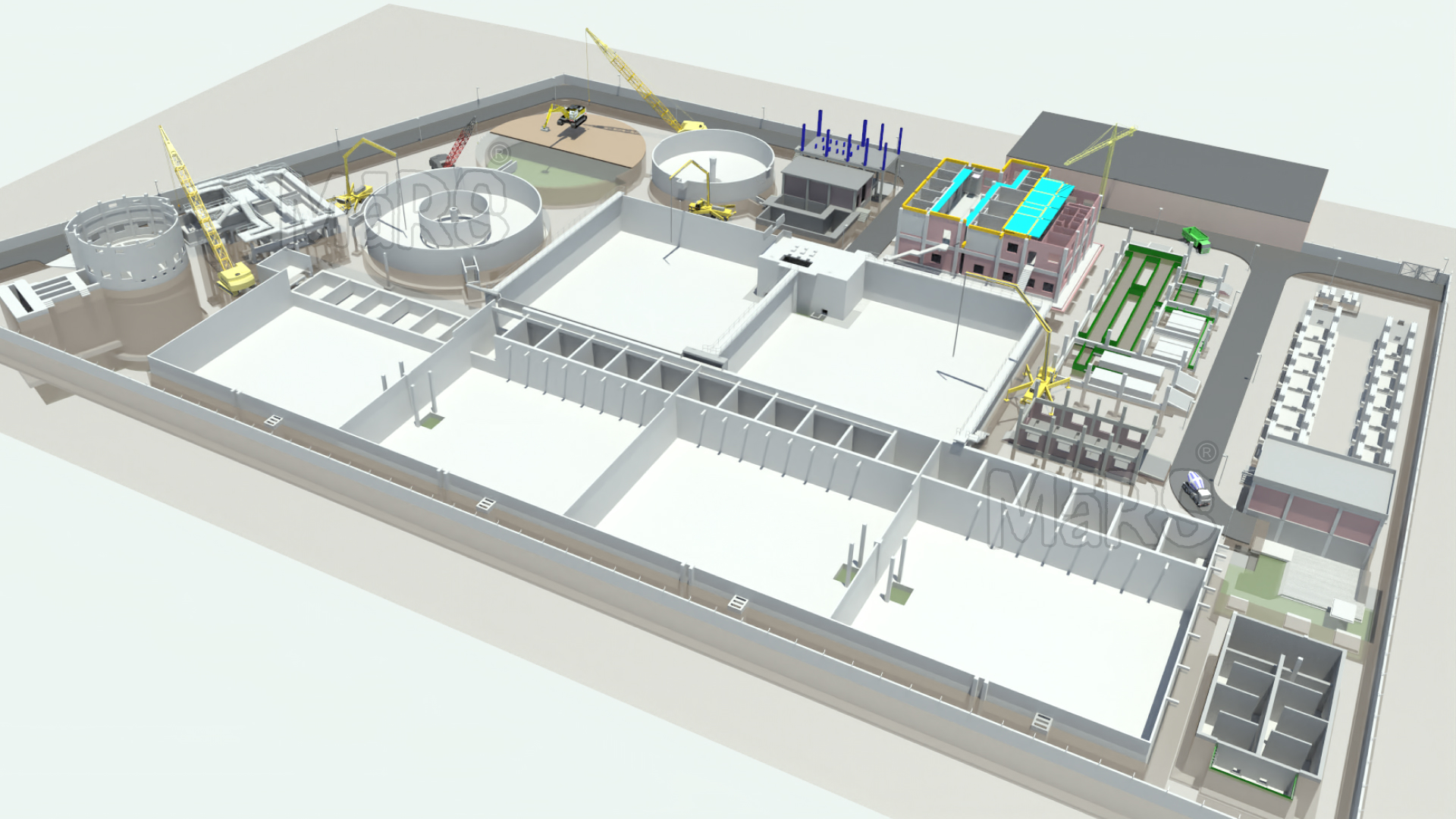
In the 30 MLD Common Effluent Treatment Plant project in Ahmedabad, MaRS BIM Solutions applied 4D scheduling to coordinate an environmentally complex infrastructure build covering 160,000 sq.m. The project addressed a pressing need to manage industrial wastewater and eliminate unauthorized discharge into the Sabarmati River. Using Bentley Synchro 4D along with Revit and AutoCAD, the team created a time-linked model that visualized the sequencing of structural, mechanical, and pipeline installations. The scheduling model helped align activities across trades and resolve complex system conflicts before site execution, significantly improving coordination among contractors, regulatory bodies, and engineering teams. The 4D model supported regulatory approvals through visual presentations that clarified construction intent and phasing.
The sequencing strategy built into the 4D model helped the client optimize equipment staging, manage phased area turnovers, and streamline procurement tied to actual installation timelines. During execution, the model served as a real-time reference for workflow monitoring and issue resolution. Integration with 5D budgeting ensured tighter financial tracking, while real-time updates reflected actual progress, creating a continuously evolving model tied to field activities. This approach enabled the team to complete BIM implementation within six months of a three-year construction cycle, improving environmental compliance and reducing rework. The model laid the foundation for a digital twin used in post-construction operations, contributing to predictive maintenance, leak detection, and ESG compliance through sensor-driven monitoring and analytics.
MaRS BIM’s Collaborative Approach with Contractor Teams
Sequence Validation Based on Crew Movement and Shift Logic
Teams collaborate with site engineers to structure the 4D model around actual labor shifts, access zone transitions, and inter-trade handoffs within confined treatment zones or structural bays.
Trade Stacking Reviewed with Live Lookahead Plans
Weekly look ahead inputs from planning engineers are fed into the model to test zone occupancy, ensuring that electrical, piping, and civil teams operate without overlap in narrow service corridors.
Dynamic Updates Based on Field-Driven Adjustments
When subcontractors adjust installation strategies due to weather, labor constraints, or material lag, the 4D model is immediately updated to reflect revised sequences for all downstream activities.
Client Sign-Off Support Using Real Phasing Simulation
Contractors use MaRS-generated 4D timelines to walk regulatory authorities through construction logic for phased inspections, treatment chamber closures, or milestone approvals.
System-Specific Coordination Across BIM Packages
Structural tank walls, embedded pipes, aeration systems, and SCADA components are scheduled in the model based on real assembly logic, not just IFC model geometry aligning technical and on-site workflows.
Site-Responsive Simulation for Logistics and Crane Access
Crane zones, formwork movement, and heavy MEP lift plans are built into the model to coordinate lifting windows, staging needs, and safe movement through shared work zones.
Pro tip: Start 4D construction scheduling during tender reviews to flag sequencing issues tied to crane zones, core access, and MEP turnover. Early simulation supports trade-level buy-in and prevents rework during mobilization.
Conclusion
4D construction Scheduling with MaRS BIM Solutions enables contractors to build around actual conditions, not assumptions. Every model is tailored to reflect field logistics, trade-specific timelines, and sequencing logic aligned with real installation constraints. This supports better handoffs, improves shift planning, and keeps critical paths responsive to change. Teams use the 4D model as a live coordination layer from preconstruction reviews to daily site updates. It becomes a central tool for progress tracking, issue resolution, and milestone validation. Contractors adopting this approach stay ahead of delays, manage resources with precision, and maintain execution control even on technically demanding builds.