The AEC industry, engineers lead with data-first decision-making powered by structural BIM services and integrated systems. As construction shifts toward digital fabrication, 3D printing introduces new structural strategies, enabling engineers to construct directly from coordinated BIM models. These models, enriched with parametric logic, allow for generative forms, optimized material usage, and real-time fabrication control without breaking continuity between design and construction. This seamless pipeline enhances design fidelity, reduces manual interpretation, and opens new structural typologies, in projects where geometry, time, and site conditions demand precision.
This guide is engineered for professionals evaluating performance-based construction approaches, comparing Printed vs Conventional Structures from a BIM coordination, structural delivery, and material application perspective. Both methods offer distinct advantages when deployed within intelligent modeling environments. Through this comparison, engineers gain clarity on how digital manufacturing complements proven construction systems across lifecycle phases from model authoring and structural simulation to on-site assembly and long-term asset management.
As project scopes expand across infrastructure, commercial, and sustainable development, the synergy between BIM and digital fabrication allows teams to meet technical goals with higher efficiency. 3D printing, when guided by federated models, enables automation of complex wall systems, integrated voids, and site-adaptive structures. Traditional 2D construction with its established sequencing, reinforcement strategies, and load-bearing standards continues to anchor high-performance delivery across structural cores, long spans, and vertical applications. When paired intelligently, these approaches form hybrid workflows that support faster approvals, real-time progress tracking, and higher precision execution in BIM-based delivery models.
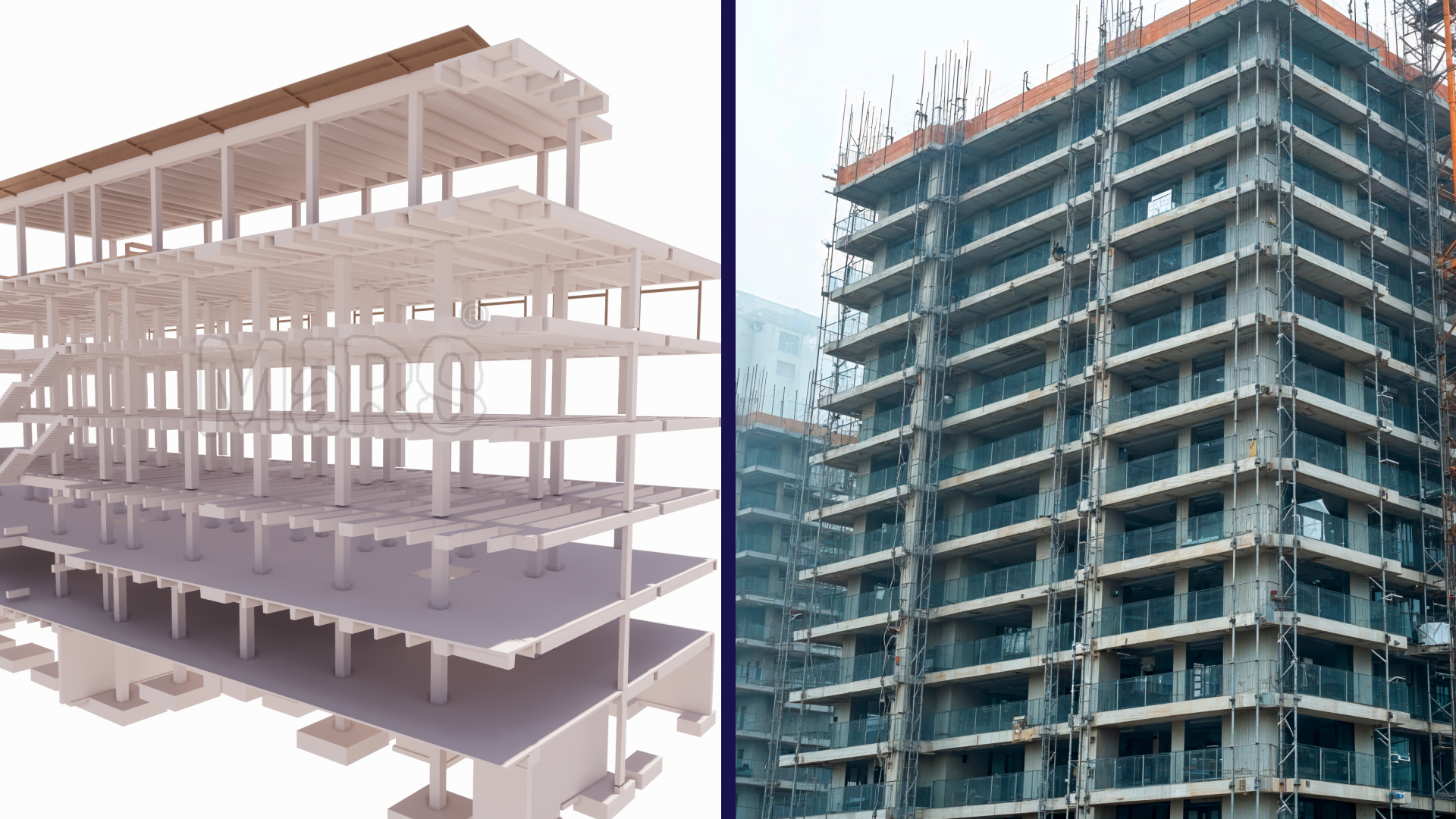
Overview of 3D Printed Structures and Traditional Construction
The distinction between 3D vs traditional building construction lies in how each method translates digital design into built reality. 3D printed structures operate through a direct digital-to-fabrication pipeline, using parametric BIM models to generate G-code or machine-readable geometry. This supports high design fidelity, custom form generation, and reduced manual interpretation. Engineers can embed structural logic, material performance data, and sensor locations directly into the BIM model execution with real-time simulation and performance tracking. The additive nature of 3D printing also allows for integrated voids, complex curves, and monolithic wall systems that minimize joints and reduce on-site coordination.
Traditional construction integrates with BIM for coordination, scheduling, and quantity takeoffs while following well-established sequencing and multi-trade workflows. It remains the preferred method for large-scale infrastructure, high-rise structures, and projects with dense MEP integration. Engineers use BIM to align structural framing with reinforcement detailing, site logistics, and staged installations. With broad compatibility across material systems like steel, concrete, and timber. It excels in delivering projects with predictable performance, codified compliance, and proven lifecycle durability. Within a hybrid BIM environment, both methods can coexist, allowing engineers to select the optimal approach based on geometry, location, timeline, and regulatory pathway.
Difference between 3D Printed vs Traditional Construction
| Aspect | 3D Printed Structures | Traditional Construction |
| BIM Workflow | Direct export from parametric BIM to G-code; no 2D drawings needed. | BIM used for LOD 300–500; drawings required for execution. |
| Wall Construction Time | 100–120 m² in under 48 hours | 100–120 m² typically takes 7–10 days including formwork, curing. |
| Labor Team Size | 3–4 trained operators per site. | 12–20 trade workers across phases. |
| Material Use | 30–60% material reduction due to optimized geometry | Fixed material volumes based on conventional standards. |
| Carbon Emissions | Avg. 58 kg CO₂-eq/m² using geopolymer mixes. | Avg. 147 kg CO₂-eq/m² for reinforced concrete. |
| Structural Height | Up to 9m self-supporting; beyond that requires hybrid frame. | Proven for 100+ meter vertical structures. |
| Permitting Codes | ISO/ASTM 52939 introduced in 2023 for structural 3D printing. | Aligned with IBC, Eurocodes, and local codes. |
| Cost Efficiency | Avg. 30% time savings; 25–40% lower labor cost | Predictable cost from historical rates; lower tech investment. |
| Design Freedom | Integrated curves, hollow voids, and embedded conduits from BIM model. | Linear geometries preferred; complex forms require extra detailing. |
| MEP Integration | Openings printed-in; post-insert of conduits and insulation. | Coordinated MEP through BIM; installed during construction sequencing. |
| Sensor Integration | Supports embedded IoT sensors for structural health monitoring. | Sensors installed during or after construction. |
| Use Case Focus | Ideal for low-rise housing, disaster shelters, and site-adaptive structures. | Broad use: towers, bridges, industrial and urban infrastructure. |
Strategic Considerations for Engineers
What 3D Printing Offers
- Executes BIM-to-G-code workflows for direct wall printing without drawings
- Completes single-story structural walls in under 72 hours on-site
- Uses real-time FEM feedback for optimized material layering
- Achieves ~58 kg CO₂-eq/m² with geopolymer-based printable mixes
- Operates with a 3–4 member crew using mobile gantry or robotic arms
- Integrates MEP chases and thermal voids directly during printing
- Embeds smart sensors mid-print for IoT-enabled performance tracking
- Deploys containerized printers with 6-hour site setup time
What Traditional Construction Still Excels At
- Delivers 40+ story towers with validated reinforced concrete systems
- Supports advanced rebar and PT detailing through Tekla Structures
- Aligns with IBC, Eurocode, IS 456 without special code approvals
- Coordinates large-scale sequencing via BIM tools like Navisworks
- Scales workforce deployment for 1,000+ concurrent site workers
- Uses materials with 100-year durability and historical load data
- Enables high-LOD MEP coordination in complex core zones
- Maintains cost certainty with mature procurement and supply chains

The Role of BIM in Bridging Both Worlds
BIM enables interoperability between 3D printing and traditional construction by serving as a common data environment for model-driven execution. Engineers use parametric tools like Dynamo or Grasshopper to generate printable geometries, while IFC-based workflows ensure alignment with structural and MEP coordination models. BIM also supports reinforcement detailing, embed tracking, and smart sensor planning within the same environment used for scheduling and cost management. This integration allows teams to synchronize layer-by-layer printing with conventional sequencing, ensuring fabrication accuracy, clash-free assemblies, and traceable QA/QC from design to delivery.
Engineering Outlook: The Hybrid Future
Hybrid construction is becoming standard, where engineers combine 3D printed elements such as walls or enclosures with conventional systems like steel frames and precast slabs. These workflows are driven by BIM-based coordination, enabling efficient sequencing, smart detailing, and reduced rework across both automated and manual construction.
To support this shift, engineers are adopting parametric modeling, material validation, and G-code optimization. As new standards like ISO/ASTM 52939 gain traction, teams must align structural logic, compliance, and site-specific performance all within a unified digital workflow.
Conclusion
For engineers navigating the shift between 3D printed structures and traditional construction, the key lies in understanding how each method supports performance, efficiency, and design intent. 3D printing offers speed, material precision, and reduced waste, while traditional systems provide scalability, code familiarity, and proven durability. This guide highlights how engineering teams can strategically apply both 3D construction methods using BIM as the unifying platform to meet evolving project demands. As digital fabrication grows, engineers equipped with hybrid knowledge will lead the next generation of construction innovation.