The construction industry in the United States is evolving fast, and BIM for electrical contractors is no longer a future concept. It is a present-day operational requirement on a growing number of public and private projects. Building Information Modeling, or BIM, has become the standard method for planning, designing, coordinating, and delivering complex construction projects. For electrical contractors, understanding what BIM Level 2 compliance actually demands is the difference between winning work and being left out of the bidding process entirely.
This article breaks down what BIM Level 2 means, why it matters specifically for electrical contractors, what tools and workflows are involved, and how electrical trade contractors can position themselves to meet project requirements without disruption to their day-to-day operations.
What Is BIM Level 2 and Why Does It Matter in the US?
BIM Level 2 is a framework for collaborative building information modeling where each discipline, including architectural, structural, and MEP coordination teams, produces and manages its own federated BIM model. These individual models are then shared, combined, and coordinated in a common data environment (CDE) to identify clashes, resolve conflicts, and align construction documents before work begins on site.
While BIM Level 2 originated as a UK government mandate, its principles have been widely adopted across the US market, particularly on federal projects, data centers, healthcare facilities, and large commercial developments. The National BIM Standard-United States (NBIMS-US) has helped establish consistent protocols across the American market.
At Level 2, the expectation is that every trade contractor maintains a discipline-specific model that is interoperable, consistently formatted, and exchangeable. For electrical contractors, that means your conduit runs, panel boards, switchgear, cable trays, lighting fixtures, and power distribution infrastructure must all be modeled with sufficient detail for coordination purposes.
Core BIM Level 2 Requirements for Electrical Contractors
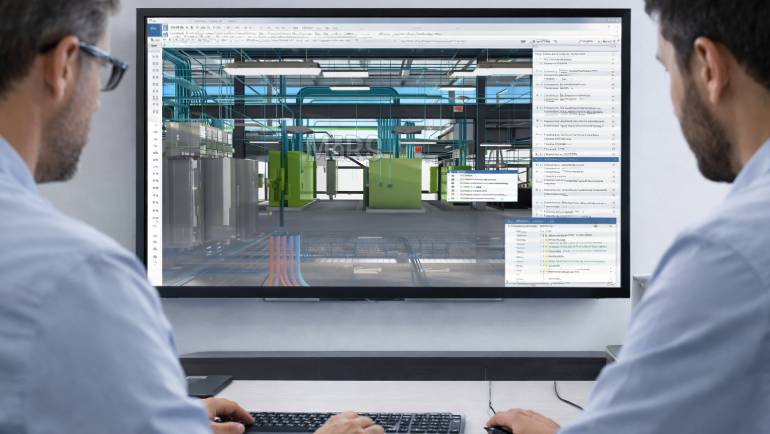
BIM Level 2 compliance for electrical work involves several specific responsibilities that go well beyond submitting basic shop drawings. Here is what electrical contractors are expected to deliver on compliant projects.
Federated Electrical BIM Model
Your team must produce a standalone electrical model in a recognized file format, most commonly IFC or RVT (Revit). This model covers the full scope of Electrical BIM Coordination including power, lighting, fire alarm, data, and low-voltage systems. The model must be authored to a defined Level of Development (LOD), typically LOD 300 to LOD 350 for coordination purposes.
Common Data Environment Participation
A common data environment is a shared digital platform where all project team members upload, review, and access project information. Platforms like Autodesk Construction Cloud, BIM 360, Procore, or ProjectWise are widely used on US projects. Electrical contractors must upload models consistently and on schedule, and ensure naming conventions and folder structures follow the project BIM Execution Plan.
Clash Detection and Resolution
One of the primary functions of BIM Level 2 is identifying and resolving spatial conflicts before they become field problems. As an electrical contractor, your model must be coordinated against the models of mechanical, plumbing, structural, and architectural teams. This process, known as clash detection, is typically conducted using Autodesk Navisworks or similar software. Electrical contractors are responsible for resolving clashes within their scope.
BIM Execution Plan Alignment
Every compliant project operates under a BIM Execution Plan (BEP), a document that defines the roles, responsibilities, deliverable formats, naming conventions, and coordination schedule for all BIM participants. Before work begins, electrical contractors must review and sign off on the BEP, confirming that their team has the software, skills, and resources to meet the stated requirements.
COBie and Asset Data Output
Some projects at BIM Level 2 also require COBie (Construction Operations Building Information Exchange) data delivery, which provides structured asset information for facility management handover. For electrical contractors, this may include submitting manufacturer data, model numbers, warranty information, and maintenance intervals for key equipment like switchboards, transformers, and emergency systems.
Compliance Process and Documentation for Electrical BIM Level 2
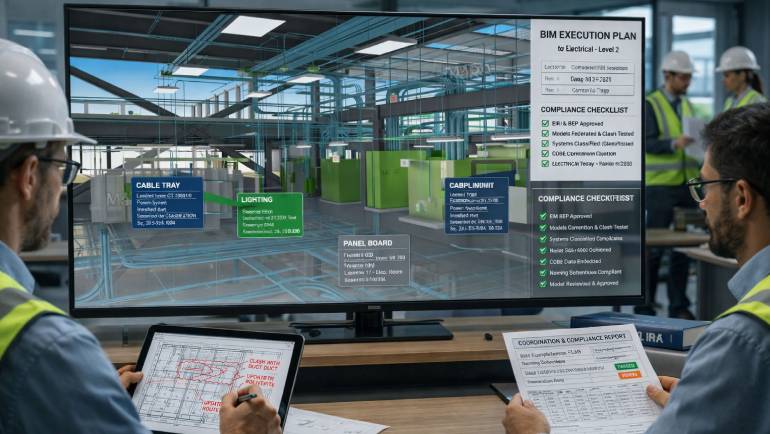
Achieving BIM Level 2 compliance is as much about process and documentation as it is about model quality. Projects can and do reject BIM deliverables that are technically well-modeled but fail to meet documentation standards.
The BIM Execution Plan
The BIM Execution Plan (BEP) is the governing document for all BIM activity on a project. Electrical contractors must review it carefully before mobilization and ensure their workflows align with its requirements. A well-structured BEP covers modeling software and version requirements, file naming conventions and folder structure within the CDE, model submission schedule and milestone dates, clash detection tolerance thresholds, responsible parties for each model discipline, and the process for issuing and resolving clash reports. Learn more about BIM Execution Plan fundamentals for design integration.
Model Submission Schedule
BIM Level 2 compliance is not a one-time delivery. Electrical contractors are required to submit updated models at regular intervals throughout the project, typically aligned with design milestone dates and coordination meeting cycles. A typical submission schedule on a mid-size commercial project looks like this.
| Submission Stage | Typical Timing | Key Electrical Deliverable |
| Initial Coordination Model | 4 to 6 weeks after contract award | LOD 300 routing for major systems, panels, cable trays |
| Coordination Round 1 | 2 weeks after initial model | First clash report response, updated routing |
| Coordination Round 2 | 2 weeks after Round 1 | Resolved clashes, confirmed spatial allocations |
| Issued for Construction Model | At GMP or 100% CD | LOD 350 fully coordinated, shop drawing-ready |
| As-Built Model | Within 30 days of project close | LOD 500 field-verified, COBie data populated |
Missing a submission milestone is a compliance failure. It delays coordination for every other trade on the project and reflects poorly on your firm with the GC and owner. Build your internal production schedule around BEP submission dates, not around when your field crew needs the information.
The Common Data Environment Workflow
Every BIM Level 2 project runs through a CDE, a shared digital repository where all discipline models are uploaded, reviewed, and approved before being used for coordination. The most common platforms in U.S. commercial construction are Autodesk Construction Cloud (ACC), BIM 360, Procore BIM, and ProjectWise.
Within the CDE, models pass through defined workflow states. Work in Progress refers to models being actively developed by the discipline team. Shared is used when the model is ready for other disciplines to reference. Published is when the model is approved for construction use. Archived refers to superseded versions retained for record. Electrical contractors must understand which state their model is in at any given time and follow the CDE’s version control protocols precisely.
Clash Detection and Resolution Documentation
Every clash identified in the coordination process must be formally documented, assigned to a responsible party, tracked through resolution, and closed out before the coordinated model can be issued for construction. Electrical contractors are responsible for responding to electrical clashes, proposing routing revisions, and updating their model to reflect agreed resolutions within the timeframes set in the BEP. Understanding how to navigate clash detection and coordination workflows is a core BIM Level 2 competency for electrical subs.
Clash reports are typically generated in Autodesk Navisworks and distributed through the CDE. Each clash has a unique ID, a description, a status, and an assigned trade. Your BIM team must review incoming clash reports within 48 to 72 hours, propose a resolution, and update the model accordingly. Unresolved clashes at the time of construction document issuance are a contractual liability.
Benefits and ROI of BIM Level 2 for Electrical Contractors
There is a strong and measurable business case for electrical contractors to fully commit to BIM Level 2. The investment in people, software, and process delivers returns that show up in field productivity, contract performance, and bid competitiveness.
Reduced Rework and Field Conflicts
Rework is one of the largest controllable cost drivers in electrical construction. Studies across the U.S. construction industry consistently show that a significant share of labor hours on commercial projects is spent correcting work that was installed incorrectly, in the wrong location, or in conflict with another trade. BIM coordination dramatically reduces these conflicts by resolving them in the digital model before the first conduit is pulled. Electrical contractors who participate fully in BIM clash detection processes report measurable reductions in field RFIs and change orders.
Fewer RFIs and Change Orders
RFIs and change orders are expensive, not just in direct cost but in schedule impact and relationship cost with the GC and owner. A coordinated BIM model answers the spatial and routing questions that would otherwise generate RFIs. For electrical contractors, this means fewer calls to the engineer of record, fewer schedule delays waiting for answers, and fewer change order negotiations. Learn how BIM reduces RFIs and change orders for general contractors, which in turn benefits every subcontractor on the project.
Prefabrication Efficiency
One of the most tangible ROI drivers of BIM Level 2 is the ability to prefabricate electrical assemblies using dimensions extracted directly from the coordinated model. Conduit bundles, rack assemblies, panel enclosures, and device rough-in frames can all be fabricated off-site with precision that is simply not achievable with traditional drawing-based workflows. Prefabrication reduces on-site labor hours, improves quality control, reduces material waste, and accelerates schedule. Explore how prefabricated MEP drawings generated from coordinated BIM models support shop fabrication.
Competitive Advantage in Project Pursuit
BIM capability is increasingly a bid requirement, not a bid differentiator. But the quality of your BIM delivery is still a differentiator. Electrical contractors who can demonstrate a track record of on-time, high-quality BIM model delivery stand out during the GC prequalification process. On negotiated projects and repeat-client work, BIM competency directly influences who gets called for the next project.
Explore how BIM for electrical contractors positions trade contractors for higher-value project opportunities.
Improved Labor Planning and Material Procurement
A coordinated BIM model is also a planning tool. Electrical contractors can extract accurate quantity take-offs from the model, generate material lists tied to specific installation zones, and sequence their labor deployment based on the coordinated construction schedule. This reduces procurement delays, minimizes excess material on site, and gives foremen clear installation targets. Learn how BIM helps trade contractors manage material procurement and delivery.
Facility Management Value at Project Handover
Beyond construction, BIM Level 2 models deliver ongoing value to building owners and operators. A well-structured as-built electrical model enables facility managers to quickly locate panels, trace circuits, plan maintenance, and manage equipment replacement. Owners who understand this value increasingly require as-built BIM deliverables in their contracts. Electrical contractors who can deliver a complete, data-rich as-built model at project close are more valuable partners. Read about how BIM supports facility management through the full building lifecycle.
ROI Summary
| Benefit Area | How It Shows Up | Typical Impact |
| Rework Reduction | Fewer field conflicts, less labor spent on corrections | 10 to 25% reduction in rework labor hours |
| RFI Reduction | Fewer information gaps, faster project pace | 30 to 50% fewer electrical RFIs on BIM projects |
| Prefabrication Savings | Lower on-site labor, better quality, faster installs | 15 to 30% labor savings on prefabricated assemblies |
| Bid Success Rate | More project pursuits won through BIM prequalification | Higher win rate on GC and owner-led selection |
| Material Efficiency | Accurate take-offs reduce over-ordering and waste | 5 to 10% reduction in material overrun |
| Client Retention | GCs and owners prefer subs with proven BIM delivery | Stronger repeat work pipeline |
Practical Steps to Achieve BIM Level 2 Compliance
Many electrical contractors have the trade knowledge but not the in-house BIM capacity. Here is a practical path to getting compliant without overhauling your entire operation.
Step 1. Understand the Project BEP Before Signing
Before committing to a project with BIM requirements, review the BEP carefully. Look for the specified LOD requirements, model submission milestones, software platforms, file format requirements (RVT, IFC, NWC), and coordination meeting schedules. Misunderstanding these requirements upfront leads to scope gaps and cost overruns.
Step 2. Build In-House BIM Capability or Partner with a BIM Provider
You have two options. You can invest in in-house BIM modelers trained on Autodesk Revit MEP, or outsource your electrical modeling to a specialized BIM coordination firm. Many electrical contractors find that a hybrid model works best, with an in-house BIM coordinator who manages deliverables and interfaces with the GC’s BIM team, supported by outsourced modeling capacity for production work. You can also hire dedicated electrical BIM modelers on a project basis to meet surges in demand.
Step 3. Engage in Coordination Meetings Early and Consistently
BIM coordination is an iterative, collaborative process. Electrical contractors who attend every coordination meeting, respond promptly to clash reports, and maintain updated models throughout the design-to-construction phase are the ones who drive the best outcomes. Passive participation is not enough, your input on spatial priorities and routing preferences shapes the final coordinated design.
Step 4. Leverage Coordinated Models for Prefabrication
One of the most tangible benefits of BIM Level 2 compliance is the ability to prefabricate electrical assemblies, including conduit bundles, panel enclosures, and device rough-in brackets, off-site using dimensions pulled directly from the coordinated model. This reduces labor on the job site, improves quality control, and accelerates installation. Review how prefabricated MEP drawings can be generated from a coordinated BIM model to support shop fabrication.
What Comes After BIM Level 2
BIM Level 2 is the current standard, but the industry is moving steadily toward greater integration and automation. Contractors who build BIM competency today are positioning themselves for BIM Level 3 environments, where models are managed in a single integrated cloud platform with real-time collaboration. Additionally, coordinated BIM models from the construction phase are increasingly being handed over to facility management teams as living digital assets, a practice governed by standards like COBie and explored further in BIM for facility management. Autodesk’s suite of construction tools continues to evolve toward this fully integrated future.
Electrical contractors who invest in BIM now are not just meeting a compliance requirement. They are building a competitive capability that compounds over time. As owners increasingly demand digital deliverables, data-rich as-built models, and integration with building automation systems, your BIM fluency becomes a direct business advantage.
Conclusion
BIM for electrical contractors is now a competitive and contractual reality on US commercial projects. Understanding BIM Level 2 compliance, investing in the right tools and partnerships, and integrating BIM workflows into your preconstruction process positions your team to win more work, reduce field conflicts, and deliver projects with greater efficiency.
Whether you are building an in-house VDC capability or working with an external partner for electrical modeling and coordination, the fundamentals remain the same. Commit to accurate modeling, engage early in the coordination process, follow the BEP, and build the kind of BIM capability that opens doors to the most demanding and rewarding projects in the market.
Explore how specialized MEP BIM services and BIM services for electrical contractors can help your team meet project requirements on any project, anywhere in the United States.