
Managing a construction project with a dozen subcontractors—each with their own drawings, schedules, and trade-specific models—is one of the most complex coordination challenges in the U.S. construction industry. Conflicts between structural steel, mechanical equipment, plumbing runs, and electrical conduit used to surface on the jobsite, costing time and money to resolve. Today, BIM for General Contractors has fundamentally changed how that coordination happens—shifting conflict resolution from the field to the digital model, weeks or even months before a shovel hits the ground.
This article explains exactly how GCs use BIM to bring multiple subcontractors into alignment, reduce RFIs, accelerate schedules, and deliver better buildings.
Why BIM Has Become Standard Practice for GCs in the U.S.?
According to Autodesk’s research on BIM adoption, projects that use coordinated BIM workflows experience significantly fewer change orders and higher on-site productivity compared to those relying on 2D drawings alone. For general contractors managing complex commercial, healthcare, or infrastructure projects, that margin is everything.
BIM gives the GC a single federated model that combines all trade disciplines—structural, architectural, mechanical, electrical, and plumbing—into one coordinated environment. Instead of resolving conflicts between paper drawings in a trailer, project teams identify and resolve issues through digital analysis, weeks before work begins on site.
Setting Up the BIM Environment for Multi-Trade Coordination
Before coordination can begin, the GC typically takes the lead in establishing the BIM Execution Plan (BEP). This document defines:
- Model ownership – which subcontractor is responsible for which model files
- LOD requirements – the Level of Development expected at each project phase
- File formats and software standards – usually Autodesk Revit and Navisworks, though other platforms like Trimble or Bentley are used on certain project types
- Coordination meeting cadence – how often the team will meet to review the federated model
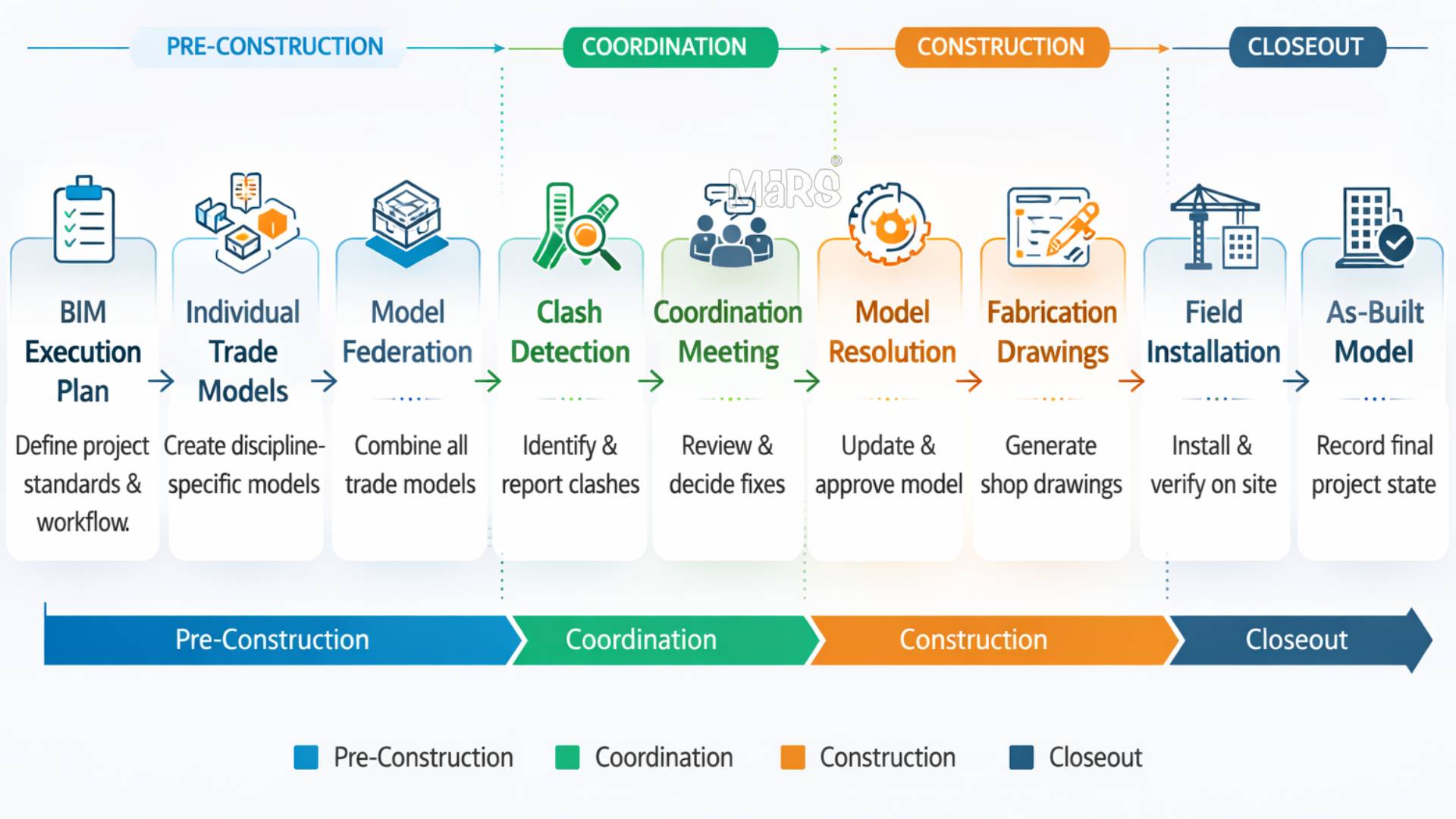
The GC acts as the model manager, aggregating individual trade models from the structural, mechanical, plumbing, electrical, and fire protection subcontractors into a single federated model. This is the foundation for BIM coordination and clash detection work that follows.
BIM Clash Detection: The Core of Subcontractor Coordination
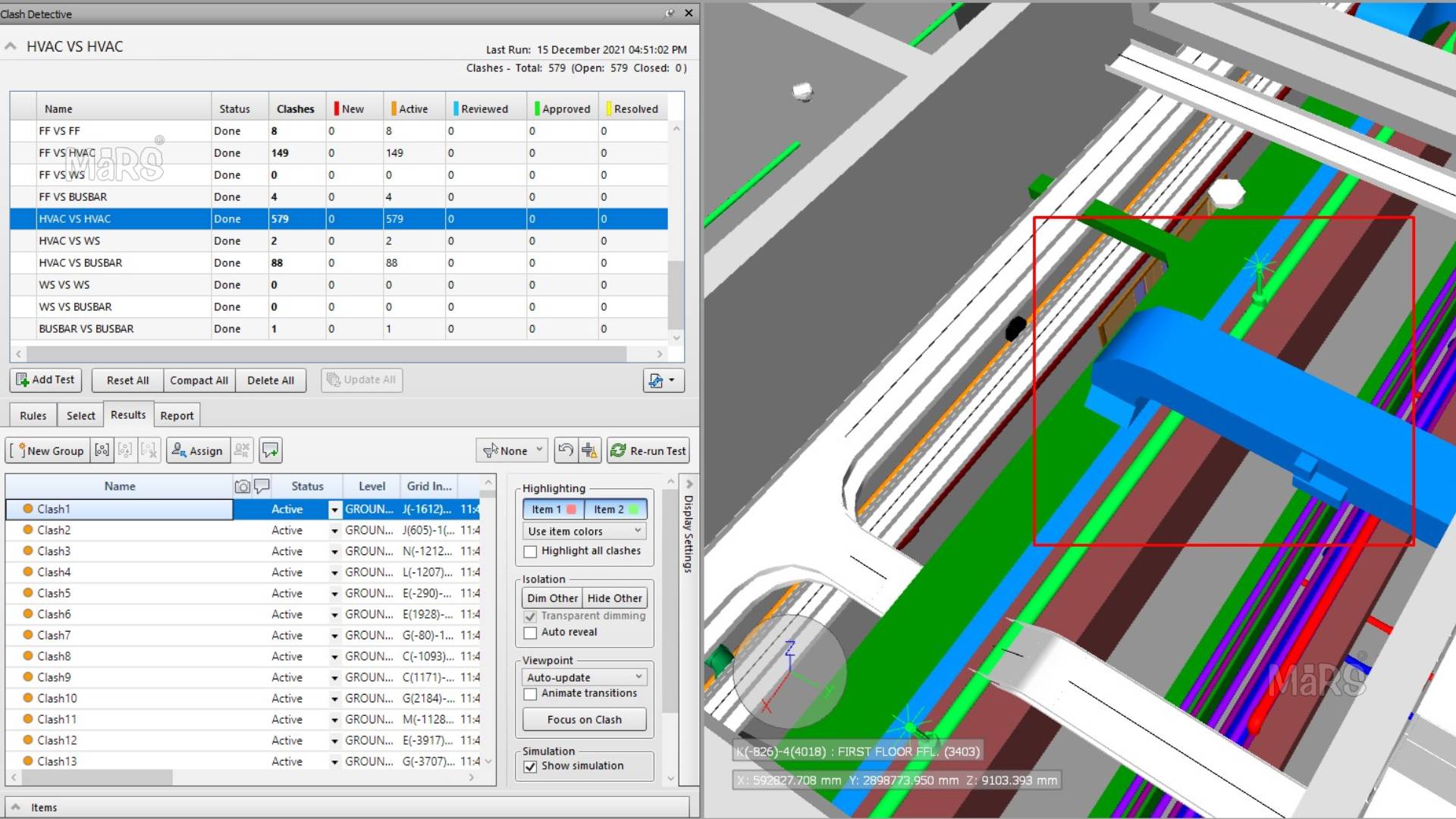
BIM Clash Detection is the process of running automated interference checks between trade models to identify where systems physically conflict in 3D space. These conflicts—or “clashes”—fall into three categories:
- Hard clashes: Two objects occupying the same physical space (e.g., a duct running through a structural beam)
- Soft clashes: Objects violating required clearance zones (e.g., insufficient maintenance access around HVAC equipment)
- Workflow clashes: Sequencing conflicts where one trade’s work must precede another’s
Tools like Autodesk Navisworks run thousands of clash checks in minutes, generating clash reports that are assigned to the responsible trade contractor for resolution. Rather than discovering a conflict when a mechanical subcontractor’s 36-inch duct runs into a beam at 14 feet, the GC catches it at the coordination table—and the trade revises their model before fabrication drawings are issued.
This is where MEP coordination becomes critical. The mechanical, electrical, and plumbing trades typically generate the highest volume of clashes against structural and architectural elements, and against each other. A coordinated MEP routing strategy—agreed upon in the BIM environment—determines the final installation sequence on the job site.
How Each Trade Interacts with the GC’s BIM Workflow?
BIM for Mechanical Contractors
BIM for Mechanical Contractors enables the HVAC trade to model ductwork, air handling units, VAV boxes, piping, and associated equipment in three dimensions at fabrication-level detail. Once a mechanical model reaches LOD 350 or higher, it contains enough information to drive HVAC duct shop drawings and prefabricated duct sections directly.
The GC uses the mechanical model to verify that major equipment placements align with structural loading capacities and that ductwork routing does not compromise ceiling heights or corridor clearances that affect the owner’s program.
BIM for Electrical Contractors
BIM for Electrical Contractors involves modeling conduit runs, cable trays, panel boards, switchgear, lighting fixtures, and data pathways in 3D. Electrical models are frequently the source of soft clashes—conduit clusters that technically clear structural elements but leave no room for other trades or future maintenance.
The GC coordinates electrical routing through the federated model to prevent these situations, prioritizing space for larger mechanical and plumbing systems first, then routing electrical around them. Electrical modeling and coordination ensures conduit routing is clash-free before installation begins, reducing the costly field rerouting that has historically plagued electrical subcontractors on congested floors.
BIM for Trade Contractors (Plumbing, Fire Protection, and Others)
BIM for Trade Contractors extends beyond MEP into specialty trades like fire protection, structural steel, precast concrete, and curtain wall systems. Each of these trades develops their own federated model component:
- Plumbing contractors model sanitary, domestic water, and gas piping using plumbing modeling and coordination workflows
- Steel fabricators produce detailed shop models used to generate steel detailing documents and drive CNC fabrication
- Fire protection contractors model sprinkler heads, mains, and branches to ensure proper coverage and avoid conflicts with other overhead systems
The GC manages the coordination between all these models, using the clash detection workflow to ensure every trade can install their work without interference.
The Coordination Meeting: Turning Clash Reports into Decisions
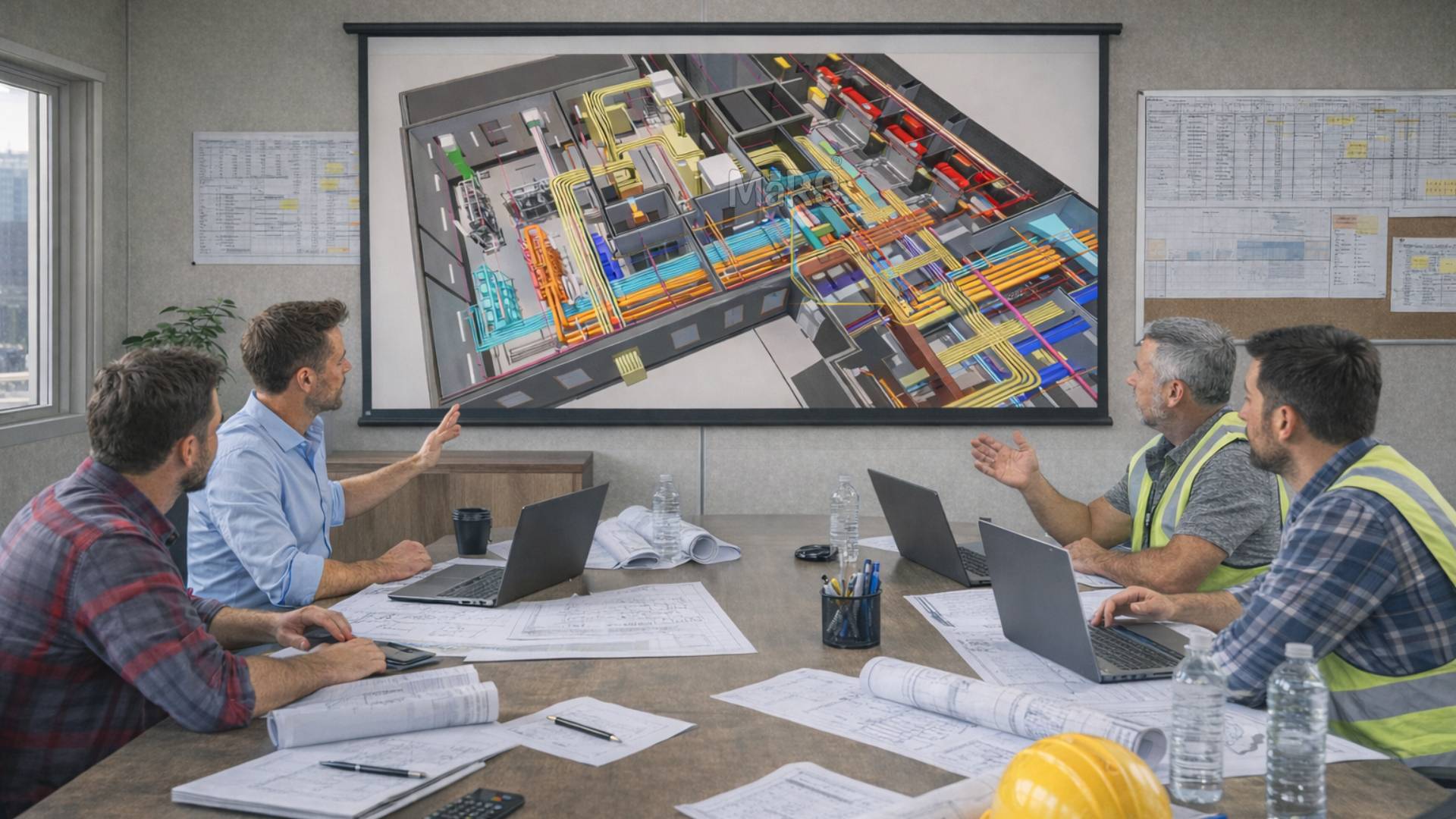
One of the most underappreciated aspects of BIM coordination is the coordination meeting itself. The GC typically chairs weekly or bi-weekly BIM coordination sessions where trade superintendents, BIM modelers, and project engineers review the current clash report together.
Each clash is assigned a status—Active, Proposed, Resolved—and the responsible subcontractor is accountable for updating their model before the next meeting. Over the course of a project, these sessions drive thousands of model revisions that collectively eliminate nearly all field interference issues in advance.
The GC’s project manager uses the federated model not just for clash resolution but also for 4D scheduling, linking model elements to the project schedule to identify sequencing conflicts between trades. If the mechanical rough-in is scheduled before the structural steel is complete in a given zone, the 4D model makes that visible—and the schedule gets adjusted before work begins.
Prefabrication: Where BIM Coordination Creates Real Cost Savings
One of the most significant downstream benefits of rigorous BIM coordination is its role in enabling prefabrication. When trade models are fully coordinated and clash-free, mechanical contractors can send ductwork segments and plumbing assemblies to a fabrication shop with confidence that the pieces will fit when they arrive on site.
The GC benefits directly from this: fewer deliveries, faster installation cycles, reduced labor hours in the field, and cleaner sequencing between trades. Prefabricated MEP drawings are produced directly from the coordinated BIM model, eliminating the manual redrawing step that used to introduce errors.
This workflow is particularly valuable on hospital, laboratory, and data center projects where MEP density is high and schedule compression is constant.
BIM for Construction Management: Beyond Coordination
General contractors are increasingly extending BIM beyond clash detection into broader construction management with BIM applications:
Site logistics modeling maps out crane locations, material staging areas, and access routes in 3D, helping GCs communicate logistical constraints to all subcontractors before mobilization.
5D cost estimating links model elements to cost data, giving the GC real-time quantity take-offs as design and coordination evolve. BIM quantity take-off capabilities allow project teams to validate subcontractor scopes and catch gaps before buyout is complete.
As-built modeling captures final field conditions at project close-out, producing an accurate record model that supports the owner’s facility management program through COBie BIM data exports or as-built modeling deliverables.
Common Challenges GCs Face in Multi-Trade BIM Coordination
Even with the right tools and processes, GCs frequently encounter several practical challenges:
Model quality inconsistency: Not all subcontractors have the same BIM capability. A GC may receive a poorly developed model from a smaller trade contractor that requires significant rework before it can be federated. Establishing clear LOD expectations in the BEP—and enforcing them—mitigates this risk.
Late model submissions: Coordination only works if all trade models are submitted on schedule. GCs often use contractual BIM requirements and milestone-based submission gates to maintain model currency.
Software compatibility: While Revit is the dominant authoring tool in U.S. commercial construction, some specialty contractors use other platforms. The GC’s BIM team must be capable of importing, translating, and federating models from multiple formats.
Change management: Design changes issued late in the coordination process can invalidate work already done. GCs establish model freeze dates and change control procedures to protect the integrity of the coordinated model as construction begins.
Conclusion
BIM for General Contractors is no longer a competitive differentiator—it is a baseline expectation on commercial, healthcare, and institutional projects across the United States. The ability to federate trade models, run rigorous BIM Clash Detection, coordinate MEP systems digitally, and drive prefabrication from coordinated drawings is what separates projects that finish on time from those that spend months resolving field conflicts.
For GCs looking to strengthen their BIM coordination capability—or for trade contractors seeking to plug into GC-led BIM workflows—investing in structured coordination processes and the right technical expertise is the highest-leverage move available in today’s construction market.
According to the National Institute of Building Sciences, interoperability and coordinated digital workflows are among the top factors driving productivity improvement in the U.S. construction sector, which has historically lagged other industries in output per labor hour. BIM coordination is the mechanism through which the industry is closing that gap.