
General contractors in the United States are raising the bar. Before awarding subcontracts, they increasingly ask one question upfront: can you work in BIM? For trade contractors who cannot answer yes, that question alone eliminates them from some of the most competitive and profitable projects in the country.
This article is written for subcontractors, including electrical, mechanical, plumbing, and other trade contractors, who want to understand how Building Information Modeling (BIM) can help them get shortlisted, win bids, and build long-term relationships with general contractors.
Why General Contractors Now Require BIM from Subcontractors?
The shift is not gradual. It is structural. GCs on commercial, healthcare, data center, and federal projects now write BIM requirements directly into subcontract agreements. They expect subcontractors to submit coordinated models, participate in clash detection sessions, and deliver as-built documentation in a digital format.
According to Autodesk’s construction industry research, projects using BIM report significant reductions in rework and schedule overruns compared to projects relying on traditional 2D drawings. GCs know this. They prefer subs who speak the same digital language.
For a subcontractor, the practical reality is straightforward. If a GC is coordinating a hospital, a multi-story office tower, or a campus data center through a federated BIM model, every trade needs to contribute a coordinated model. A sub who cannot deliver that model gets replaced by one who can.
BIM for General Contractors is no longer a technology preference. It is a procurement filter.
What GCs Actually Look for in a BIM-Ready Subcontractor?
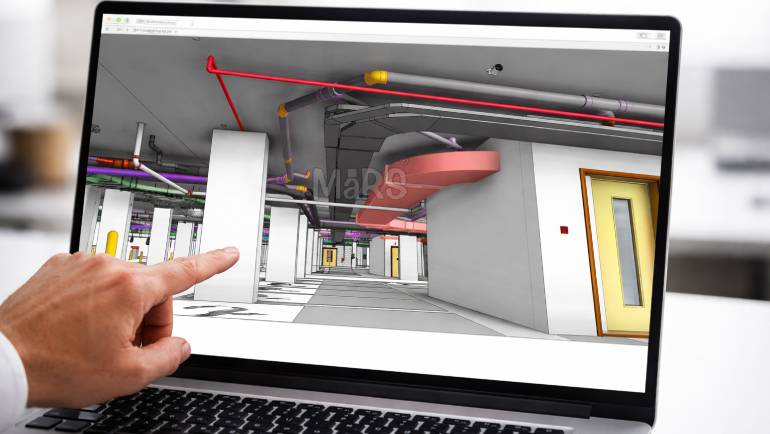
Understanding the GC’s perspective helps trade contractors position themselves correctly. Here is what GCs evaluate when vetting subcontractors for BIM-heavy projects.
Ability to Produce and Coordinate Trade-Specific Models
GCs need each trade to produce a model at the correct Level of Development (LOD). For MEP trades, that typically means LOD 300 or LOD 350 models that reflect actual installation geometry, routing, sizes, and clearances. A sub who can produce a well-structured Revit model immediately reduces coordination overhead for the GC’s BIM team.
Learn more about how BIM for Mechanical Contractors and BIM for Electrical Contractors are structured to support this type of coordination.
Participation in Multi-Trade Clash Detection
One of the highest-value activities on a coordinated BIM project is clash detection. When a duct run conflicts with a structural beam or a conduit path runs through a pipe chase, those clashes need to be resolved before crews hit the field. GCs depend on subcontractors to review clash reports, own their conflicts, and remodel accordingly.
Subcontractors who engage actively in clash detection and coordination save the GC time and reduce their own exposure to costly field conflicts. This is a concrete, visible contribution that GCs remember when the next project comes around.
Prefabrication-Ready Deliverables
GCs increasingly favor subcontractors who can prefabricate assemblies off-site. This requires BIM models detailed enough to drive shop fabrication, including spools for pipe, racks for conduit and cable tray, and pre-assembled HVAC modules. A sub who delivers
prefabricated MEP drawings from a coordinated BIM model is a GC’s preferred partner on labor-sensitive projects.
Digital Documentation and Handover
GCs are responsible for delivering digital project closeout packages to owners. Subcontractors who can produce accurate as-built modeling and structured COBie data help the GC meet their contractual obligations. This reduces the GC’s administrative burden and builds goodwill that translates into repeat work.
Four Ways Subcontractors Use BIM to Win More Bids
1. Submit BIM-Based Pre-Bid Estimates
Many GCs pre-qualify subs based on their ability to support pre-bid estimation from a model. When a sub can extract quantities directly from a BIM model rather than scaling off PDFs, their estimates are more accurate, faster to produce, and easier to defend in negotiations.
Accurate BIM quantity take-offs also reduce risk on lump-sum bids. A GC who sees that a sub’s numbers came from a model-based takeoff has more confidence in that number than one built from manual measurement.
2. Demonstrate Coordination Capability Before the Award
Some subs win work before the bid is even formally awarded because they show up with coordination experience. If a trade contractor can say they have run clash detection on multiple projects of this type and resolved conflicts that would have caused field delays, that is a compelling differentiator.
Reviewing the MEP coordination checklist and aligning your internal process with standard GC expectations is a practical step any sub can take immediately.
3. Offer Shop Drawings Derived Directly from the BIM Model
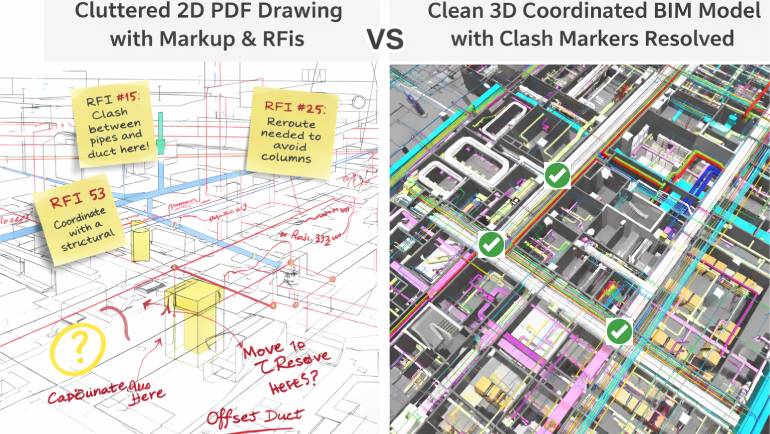
GCs spend significant time reviewing and approving shop drawings. When a subcontractor submits MEP shop drawings or HVAC duct shop drawings extracted directly from the coordinated model, the GC can cross-reference those drawings against the federated model instantly. Fewer RFIs, fewer resubmissions, faster approvals.
This workflow also reduces errors in the field because the installer is working from drawings that reflect the coordinated, clash-free model rather than a standalone interpretation of the design intent drawings.
For a broader understanding of this process, the ultimate guide for subcontractors on shop drawings is worth reviewing before your next submittal package.
4. Support 4D Scheduling Integration
On phased projects such as hospitals, occupied facilities, and fast-track tenant improvements, GCs use 4D scheduling to sequence construction activities against the model. Subcontractors who can contribute activity sequences tied to their model elements help the GC build a more reliable project schedule.
This is particularly important for mechanical and electrical trades where equipment procurement lead times directly affect the critical path. A sub that flags long-lead items early using model-based data is providing real value beyond just installation.
BIM for Trade Contractors: The Practical Starting Point
Many trade contractors know they need BIM but are unsure where to start. The good news is that getting BIM-capable does not require hiring a full in-house Revit team from day one.
Partner with a BIM Services Provider
The fastest route for most small to mid-sized subcontractors is to work with an outsourced BIM services partner. This gives you access to modelers, coordinators, and BIM managers without the overhead of building that capability internally. The MEP BIM services available through experienced providers cover everything from MEP 3D modeling and MEP coordination to electrical modeling and coordination and mechanical modeling and coordination.
Understand BIM Execution Plan Requirements
Most GCs on large projects require subcontractors to comply with a BIM Execution Plan (BEP). This document defines software platforms, LOD requirements, file naming conventions, model submission schedules, and coordination meeting protocols. Subcontractors who have reviewed a BEP before, or better yet contributed to one, signal maturity to any GC’s VDC team.
Understanding the BIM execution plan for design integration and the basic steps for an effective BIM execution plan helps subs speak the same language as the GC’s BIM manager from day one of preconstruction.
Know Your LOD Requirements
Level of Development determines how detailed your model needs to be and at what phase. Getting this wrong wastes modeling time and frustrates the GC’s coordination team. A sub who delivers LOD 200 geometry when the project requires LOD 350 will be asked to remodel, and that creates friction before a single fixture has been installed. The level of detail LOD guide is a practical reference for understanding what GCs expect at each project phase.
How BIM Specifically Helps Electrical and Mechanical Contractors?

BIM for Electrical Contractors
Electrical subcontractors deal with dense routing challenges. Conduit runs, cable tray, switchgear clearances, and panel placements all need to be coordinated with structural members and other MEP systems. BIM for Electrical Contractors enables electricians to model conduit paths and raceway systems in three dimensions, identify interference before the first piece of EMT is bent, and generate installation drawings that match field conditions.
On large commercial and industrial projects, electrical subcontractors using BIM have a measurable advantage in preconstruction coordination meetings. GCs notice and prefer subs whose foremen show up to those meetings with a model open on a tablet rather than redlined prints. The article on why electrical contractors need BIM before starting site work explains this dynamic in detail.
BIM for Mechanical Contractors
Mechanical subcontractors handle some of the most spatially complex systems in any building, including large-diameter ductwork, chilled water piping, AHUs, and rooftop equipment. BIM for Mechanical Contractors enables HVAC and piping trades to resolve conflicts with structural and architectural elements in the model before fabrication begins.
The value is magnified on projects with tight mechanical rooms or congested ceiling plenums. A mechanical sub who can produce a fully coordinated, fabrication-ready model is worth significantly more to a GC than one who shows up on-site and starts improvising routing in the field. How BIM supports multi-trade coordination for mechanical and electrical contractors explores how these two trades interact within a coordinated BIM workflow.
The Long-Term Relationship Payoff
Winning the first BIM-required project is the beginning, not the end. GCs who find a subcontractor that performs well in a coordinated BIM environment, shows up to coordination meetings, resolves clashes responsibly, and delivers on time, will bring that sub back.
This is how BIM for Trade Contractors becomes a business development strategy, not just a technical requirement. A mechanical or electrical sub who is a reliable BIM partner to three or four large GCs in their market has a significant competitive advantage. They get invited to bid first, they get preferred relationships on negotiated work, and they get called when a GC needs a trusted partner on a complex project.
According to the National Institute of Building Sciences, the construction industry loses billions annually to poor information management and coordination failures. Subcontractors who solve that problem for their GC partners become indispensable.
The top 4 benefits of BIM for contractors and why contractors require MEP BIM for a construction project provide additional framing on why this investment pays off commercially.
Getting Started: A Practical Checklist for Subcontractors
- Review the BIM requirements on your next three bid invitations and note where gaps exist in your current capability
- Connect with a BIM services provider who has experience with your trade and the project types in your market
- Request a sample coordinated model from a past project you can show GCs during preconstruction conversations
- Attend a multi-trade coordination meeting as an observer on a project where you are not yet the sub to see how the GC’s VDC team runs the process
- Train at least one project manager or field superintendent to read and navigate a Revit or Navisworks model
The BIM implementation support available through experienced BIM firms can help subcontractors build this capability without disrupting existing project workflows.
Conclusion
The construction market in the United States has reached a tipping point. BIM is no longer the domain of architects, engineers, and large GC VDC departments. It is now a baseline expectation for trade contractors who want to compete for complex, high-value projects.
Subcontractors who invest in BIM capability, whether through in-house staff, outsourced partners, or a combination of both, position themselves to win more work, build stronger GC relationships, and reduce costly field conflicts. Those who wait risk being screened out before the bid is even formally opened.