
Electrical contracting is one of the most coordination intensive trades in the construction industry. From conduit routing and panel schedules to cable trays and fire alarm systems, the sheer volume of electrical scope on a typical commercial project demands precision, documentation, and tight collaboration with other trades. Yet many electrical contracting firms across the United States are still working from 2D drawings, catching conflicts in the field, and absorbing the cost of rework that could have been prevented upstream.
BIM adoption for electrical contracting firms is no longer a competitive edge reserved for large ENR firms. It is becoming a baseline requirement on federally funded projects, hospital and healthcare facilities, data centers, and large-scale commercial construction across major U.S. markets. BIM for General contractors are increasingly requiring BIM compliant coordination from all trade partners before work begins on site.
This guide walks electrical contracting firms through the practical realities of BIM adoption, what it means for day to day operations, where to start, what to expect, and how to build long-term capability that protects margins and strengthens client relationships.
What BIM Actually Means for Electrical Contractors?
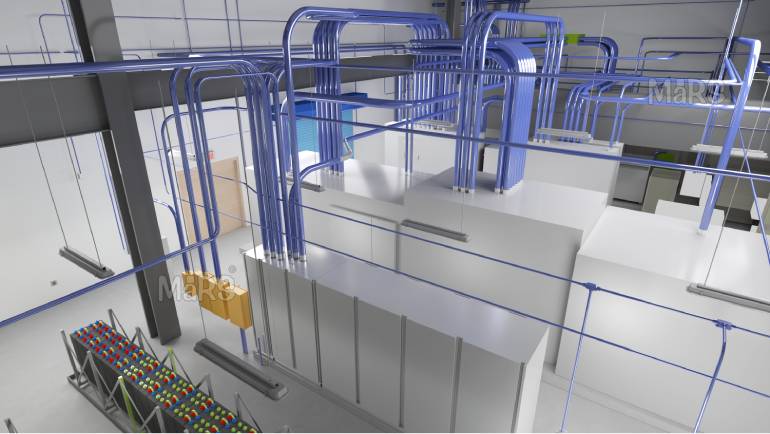
BIM is the process of creating and managing digital representations of a facility’s physical and functional characteristics. For electrical contractors, this translates into a 3D model that includes all conduit runs, raceways, cable trays, junction boxes, panels, switchgear, lighting fixtures, and low-voltage systems, coordinated spatially with structural steel, HVAC ductwork, plumbing, and architectural elements.
Unlike traditional 2D drawings, a properly developed electrical BIM model allows the team to detect clashes before installation, generate accurate material quantities, support prefabrication, and produce as-built documentation that can be handed off to the building owner for facility management.
According to Autodesk, BIM workflows improve project delivery outcomes across all construction disciplines when properly implemented, reducing field conflicts and supporting downstream lifecycle management. For BIM for electrical contractors specifically, the tangible outcomes are fewer RFIs, less rework, and improved prefabrication potential.
Why Electrical Firms Are Accelerating BIM Adoption Now?
Several market forces are pushing BIM adoption in the electrical trade faster than many firms anticipated.
General Contractor and Owner Requirements
General contractors managing complex projects now routinely require BIM compliant coordination from all subcontractors before mobilization. Firms that cannot participate in federated model reviews, clash detection sessions, or BIM coordination meetings are increasingly being passed over during the bidding process. How general contractors use BIM to coordinate multiple subcontractors illustrates how this coordination flow works on real projects.
Growing Project Complexity
Hospitals, data centers, mission critical facilities, and mixed use high rise projects all carry dense electrical scope, often with multiple systems running through the same congested ceiling cavities. 2D drawings are insufficient for resolving these conflicts at the coordination stage. BIM for trade contractors brings all systems into a single shared model environment where conflicts can be identified and resolved before any labor hits the field.
Prefabrication and Labor Efficiency Demands
Labor shortages across the electrical trade are driving interest in prefabrication. BIM models are the foundation of effective prefab programs, they provide the precise geometry needed for cutting conduit offsets, prebuilding assemblies, and staging modular units that install with minimal field adjustment. Without a model, prefab at scale is guesswork.
Key Benefits of BIM for Electrical Contracting Firms
Clash Detection and Conflict Resolution
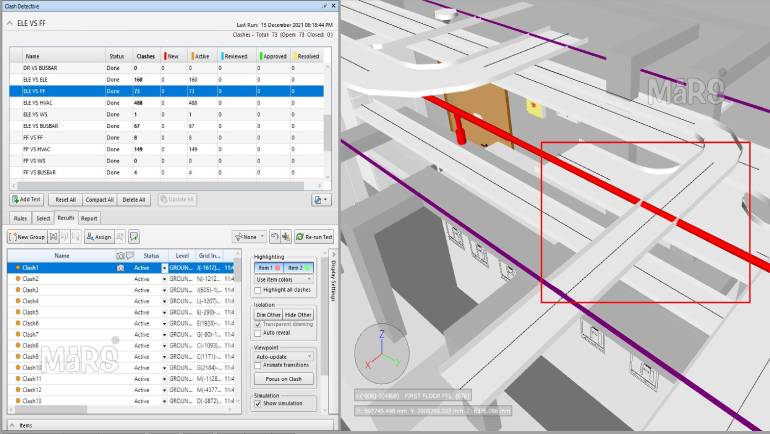
One of the most direct financial benefits of BIM adoption is the ability to catch spatial conflicts before construction begins. A conduit run that cuts through a structural beam, or a cable tray that conflicts with HVAC ductwork, can cost far more to fix in the field than to resolve in a model. How BIM clash detection saves trade contractors from costly rework explains the cost dynamics in detail.
Reduced RFIs and Change Orders
Electrical contractors that participate in BIM coordination consistently report significant reductions in Requests for Information (RFIs) and change orders during construction. When routing decisions, clearances, and installation sequences are resolved in the model, field crews work from information that is validated rather than interpreted. This directly reduces administrative burden on project managers and protects schedule.
Accurate Quantity Takeoffs and Estimating
A fully coordinated BIM model provides the geometry needed for reliable material extraction. Conduit lengths, wire quantities, fixture counts, and device locations can all be pulled directly from the model, reducing manual takeoff time and improving bid accuracy. This capability supports BIM quantity take-off workflows that compress estimating cycles without sacrificing accuracy.
Better Shop Drawings and Installation Documents
BIM generated shop drawings for electrical work provide field crews with coordinated, dimensionally accurate installation documents that reflect real field conditions, not idealized design intent. These drawings reduce interpretation errors, support faster installation, and create a clear record for inspections and commissioning.
How to Start Your BIM Adoption Journey?
Most electrical firms do not need to build a full in-house BIM department from day one. A phased approach, starting with participation in coordinated model reviews and gradually building internal capability is both practical and financially sustainable.
Step 1 – Assess Your Current Workflows and Project Types
Before investing in software or personnel, audit the project types you typically pursue. Healthcare, data centers, federal buildings, higher education, and large commercial projects are sectors where BIM is already expected or mandated. If 40% or more of your work falls into these categories, BIM adoption is urgent. If you work primarily in light commercial or residential, the timeline can be extended, but the direction of the market is clear regardless.
Step 2 – Choose the Right Software Platform
Autodesk Revit MEP is the dominant platform for electrical BIM modeling in the U.S. market. Most general contractors and design teams use Revit as the federated model environment, which means electrical contractors need to work in or deliver to Revit-compatible formats. Other platforms such as Trimble’s AutoCAD-based workflows and Navisworks for clash detection are also widely used. Understanding what your GC partners require is the first filter for software selection.
According to Wikipedia’s overview of Building Information Modeling, BIM encompasses both the process and the tools used to digitally represent a built asset, with interoperability between platforms being a key challenge that the industry continues to address through open standards like IFC.
Step 3 – Build Internal Capability or Partner Strategically
Electrical firms have two realistic paths. The first is hiring or training in-house BIM modelers and coordinators, a longer runway but builds permanent capability. The second is partnering with a specialized BIM services provider to develop coordinated electrical models on a project-by-project basis while internal staff develops familiarity with model navigation and review.
Many firms start with the second path and transition to the first over 18 to 36 months. The key is ensuring your field leadership and project managers can read, navigate, and contribute to model-based coordination sessions even if they are not producing the models themselves.
Step 4 – Understand BIM Execution Plans
On projects that require BIM, a BIM Execution Plan (BEP) defines the project-specific requirements, Level of Development (LOD) for each system, file sharing protocols, coordination meeting schedules, clash detection tolerances, and deliverable requirements. Every electrical contractor participating in BIM-required projects should be able to read and respond to a BEP. Firms that understand BEP requirements avoid scope gaps and can price BIM-related scope accurately.
Common Challenges Electrical Firms Face During BIM Adoption
BIM adoption is not frictionless. Electrical firms should anticipate and plan for the following barriers.
- Software cost and licensing fees for Revit, Navisworks, or equivalent platforms can be significant for smaller firms. Cloud-based subscription models have lowered the entry barrier but still represent a real overhead increase.
- Training time is substantial. An electrician or project manager transitioning to BIM modeling typically needs 3 to 6 months of structured training before becoming productive on live projects.
- Data management and file sharing protocols require coordination with the general contractor’s BIM management team. Firms that are unfamiliar with Common Data Environments (CDEs) such as Autodesk Construction Cloud or Procore face a learning curve on project setup alone.
- Resistance from experienced field staff who are accustomed to working from 2D drawings is a human factor challenge that is often underestimated. Change management and leadership buy-in are as important as technical training.
Understanding these challenges in advance allows firms to budget realistically and set internal expectations. BIM adoption challenges for general contractors and how to fix them offers a broader look at how adoption barriers manifest across different firm types.
Electrical-Specific BIM Workflows That Deliver Real Value
Electrical Modeling and Multi-Trade Coordination
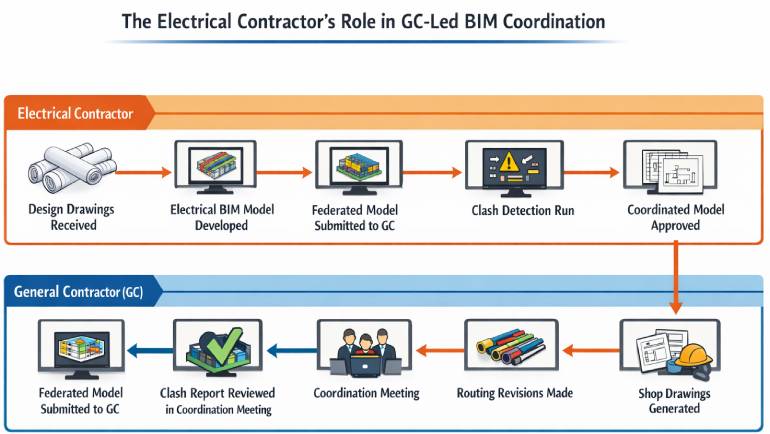
The core workflow for BIM for electrical contractors involves developing a 3D model of all electrical systems power distribution, lighting, fire alarm, low-voltage data and communications, and emergency systems and then federating that model with mechanical, plumbing, and structural models for coordination review. Electrical modeling and coordination services cover this process in detail, from initial model setup through coordinated shop drawing production.
MEP Coordination and Clash Resolution
MEP coordination is the discipline-level process by which mechanical, electrical, and plumbing systems are spatially reconciled in a shared model. For electrical contractors, this means participating in weekly or bi-weekly coordination meetings where clash reports are reviewed and routing adjustments are agreed upon with other trades. The quality of MEP coordination directly determines how cleanly work installs in the field.
4D Scheduling and 5D Cost Integration
Advanced BIM workflows link the 3D model to project schedules (4D) and cost data (5D). For electrical contractors, 4D scheduling allows foremen and project managers to visualize the construction sequence, identify logistical conflicts with other trades, and plan manpower deployment more effectively. 5D cost integration connects model elements to budget line items, giving estimators and project controls teams real-time visibility into scope vs. cost alignment.
In-House BIM vs. Outsourced BIM Services
A frequent question during BIM adoption is whether to build internal capacity or outsource BIM modeling to a specialized provider. The answer depends on firm size, project volume, and budget.
For firms with annual revenues under $20 million, outsourcing BIM production while maintaining in-house review and coordination capability is typically the most cost-effective approach. The overhead of full-time BIM staff salaries, software licenses, hardware, and training is difficult to justify without a consistent pipeline of BIM-required projects.
For larger firms pursuing federal, healthcare, or institutional work where BIM is contractually required, building an internal team is a strategic investment that pays off through tighter control of coordination timelines, faster response to model updates, and deeper integration with prefabrication workflows.
In either case, partnering with a BIM provider that understands electrical scopes, U.S. code requirements, and coordination workflows specific to the trade is essential. Generic BIM services that lack domain knowledge in electrical systems produce models that require extensive rework before they are useful in the field.
That is where MaRS BIM Solutions comes in. With deep expertise in electrical BIM modeling, U.S. code compliance, and trade-specific coordination workflows, MaRS BIM Solutions helps general contractors of all sizes adopt BIM without the overhead of building everything in-house.
Ready to streamline your BIM workflow and reduce coordination costs? Contact MaRS BIM Solutions today and find out how we can support your next project.
Working Within GC-Led BIM Environments
Electrical contractors operating under BIM for general contractors need to understand how the GC manages the overall model environment. In most project setups, the GC or their VDC manager is responsible for the federated model, the combined model that brings all trades together for coordination review. Each subcontractor contributes their discipline model to this federated environment on a schedule defined in the BEP.
Electrical contractors should be prepared to maintain model update cadences, respond to clash reports within defined timelines, and attend coordination meetings with staff who can make routing decisions on the spot. Firms that treat coordination meetings as passive reviews rather than active problem-solving sessions slow the entire team and damage subcontractor relationships.
Understanding how BIM supports multi-trade coordination for mechanical and electrical contractors is also essential for firms working across both electrical and mechanical scopes on integrated projects.
Measuring the ROI of BIM Adoption for Electrical Firms
ROI from BIM adoption materializes in several measurable areas for electrical contracting firms.
- Rework reduction is typically the largest single value driver. Even a 10% reduction in rework labor on a $5 million electrical contract represents a material improvement to project margin.
- Prefabrication savings from model-based prefab programs can reduce on-site labor hours by 20% to 35% on dense MEP projects, with corresponding reductions in material waste.
- RFI reduction lowers administrative overhead. Fewer RFIs mean less time spent by project managers chasing information and more time spent managing productive work.
- Bid success rate improvements in BIM-required project categories are a longer-term but strategically important return on investment for firms building this capability.
Tracking these metrics project-by-project gives leadership the data needed to justify continued BIM investment and identify where workflows need refinement.
Final Thoughts
BIM adoption for electrical contracting firms in the United States is not a future consideration. It is a present-day competitive reality. The firms that are building BIM capability today are the ones that will win the contracts, retain skilled workers, and deliver projects with the efficiency and documentation quality that owners and general contractors increasingly demand.
Starting does not require perfection. It requires a clear understanding of what BIM means for electrical scope, a realistic plan for building capability, and the willingness to invest in workflows that reduce field surprises, protect margins, and strengthen the firm’s position in a competitive market.
Whether you are coordinating a hospital fit-out in Houston, a data center in northern Virginia, or a mixed-use tower in Chicago, the process starts with the model. Build that capability now, and the field results will follow.