
Building Information Modeling (BIM) has fundamentally changed how construction projects are planned, coordinated, and delivered across the United States. Yet for many general contractors, the path to full BIM adoption remains one of the most complex operational challenges they face. The technology exists. The benefits are well-documented. And increasingly, project owners from federal agencies to major commercial developers are mandating BIM as a condition of contract.
So why do so many GCs still struggle with BIM adoption?
The answer is rarely a single obstacle. It is usually a combination of financial pressures, workforce gaps, workflow disruptions, and vendor coordination issues layered on top of each other. This article breaks down the most common barriers to BIM for General Contractors to face in the U.S. construction market, and more importantly, what steps to take to fix them.
Why BIM Adoption Is No Longer Optional for General Contractors?
A decade ago, BIM was a competitive differentiator. Today, it is quickly becoming a baseline expectation on mid-to-large scale projects across commercial, healthcare, infrastructure, and federal sectors. The U.S. Army Corps of Engineers and General Services Administration have required BIM on federally funded projects for years, and private owners have followed suit.
For general contractors, BIM is not just about producing 3D models. It enables real-time clash detection, improves subcontractor coordination, links to 4D scheduling and 5D cost estimating, and creates a digital record that supports operations through the life of the building. Firms that have not built internal BIM capability or partnered with BIM specialists are increasingly finding themselves excluded from bid shortlists.
Understanding what is holding your firm back is the first step to closing that gap.
High Upfront Costs and Unclear ROI
The Problem
BIM software licenses, hardware upgrades, and staff training represent a significant capital investment. For small and mid-sized general contractors working on thin margins, the upfront cost of BIM adoption can feel unjustifiable especially when projects are won and staffed on traditional 2D drawing workflows.
Many GC leadership teams struggle to quantify BIM return on investment in concrete terms. Without clear data showing how BIM reduces RFIs, change orders, and rework costs on their specific project types, the investment decision stalls.
The Fix
Start by calculating BIM impact on a single recent project retroactively. Identify how many RFIs were issued, how many change orders arose from coordination failures, and what rework cost in labor hours. Even conservative estimates typically reveal that BIM would have reduced those figures by 20-40%.
If internal investment is premature, the more immediate solution is to outsource BIM modeling and coordination to a specialist firm. This converts the fixed capital cost into a project level variable cost, allowing your firm to deliver BIM compliant projects while building internal capability over time. Services like
BIM implementation support and construction management with BIM allow GCs to scale BIM engagement without large upfront commitments.
Workforce Skills Gaps and Resistance to Change
The Problem
The U.S. construction industry faces a persistent skilled labor shortage, and BIM-proficient staff are among the hardest to recruit and retain. Many experienced project managers, superintendents, and estimators built their careers on 2D CAD workflows and are reluctant or in some cases unable to transition to model-based processes.
This creates a two-sided problem. Senior staff hold institutional knowledge that is critical for project delivery, but they are often the same people most resistant to BIM workflows. Meanwhile, younger staff entering the workforce may have BIM software familiarity but lack the field and project management experience to apply models effectively.
The Fix
Avoid top down mandates that create resentment. Instead, identify one or two internal BIM champions ideally people with credibility across the project team and build training around their early successes. A single well-executed BIM coordination effort on a live project is far more persuasive than a training seminar.
For GCs who need BIM capability immediately, hiring dedicated BIM resources either on a project basis or as extended team members is the most practical solution. Options such as dedicated BIM coordinators and BIM managers allow GCs to staff BIM workflows without requiring every existing employee to retrain immediately.
Coordinating BIM Across Multiple Trade Contractors

The Problem
A general contractor’s BIM model is only as useful as the data contributed by the trade contractors working beneath them. On a typical commercial project, this means coordinating BIM inputs from mechanical, electrical, plumbing, structural steel, and specialty subcontractors each potentially using different software versions, modeling standards, and levels of detail.
This is one of the most persistent friction points in multi-trade coordination. Even when the GC is fully committed to BIM, the project model breaks down if the MEP subs are still working off 2D drawings or delivering models that do not conform to project LOD requirements.
The Fix
Address BIM requirements at the contract level. BIM Execution Plans (BEPs) should be issued at bid stage, clearly specifying software platforms, model submission schedules, LOD requirements, and clash detection participation expectations for every trade. Make BIM compliance a contractual obligation, not a request.
For trade contractors who lack in-house BIM capability, GCs can facilitate outsourced BIM services on their behalf, either absorbing the cost into the project overhead or passing it through as a line item. The GC’s goal is a coordinated model, regardless of how each trade gets there.
Resources like BIM for general contractors and multi-trade coordination support allow GCs to centralize coordination and maintain model integrity across all subcontractors.
BIM for Electrical and Mechanical Contractors Remains Inconsistent
The Problem
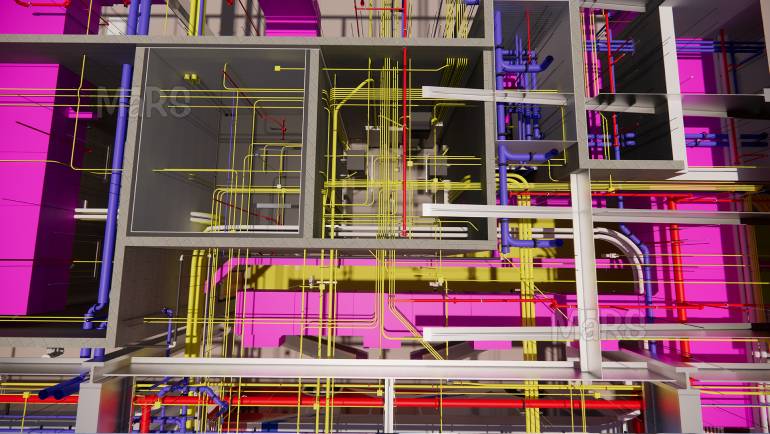
Despite widespread awareness of BIM in the construction industry, BIM for electrical contractors and BIM for mechanical contractors adoption remains highly uneven. Many smaller MEP firms in the U.S. still perform design and coordination from 2D drawings, particularly on projects below a certain dollar threshold or outside major metro markets.
This creates a direct problem for GCs. When electrical or mechanical subcontractors cannot produce or navigate a federated BIM model, coordination has to happen manually, through paper markups, field RFIs, and reactive problem-solving. The result is exactly the kind of clash-driven rework and schedule impact that BIM is designed to prevent.
The Fix
General contractors can bridge this gap in two ways. First, pre-qualify subcontractors based on BIM capability as part of the bid evaluation process not as a disqualifier for smaller firms, but as a criterion that triggers additional support or subcontracting arrangements for BIM services.
Second, provide BIM modeling services to MEP subcontractors through the GC’s own BIM partner, using the sub’s design intent drawings as input. This approach, where modeling is outsourced and delivered back to the trade for review and sign off has become increasingly common on complex healthcare, data center, and institutional projects. Dedicated services for electrical modeling and coordination and mechanical modeling and coordination support exactly this workflow.
Clash Detection Is Underutilized or Applied Too Late

The Problem
One of BIM’s most tangible and quantifiable benefits is the ability to identify spatial conflicts between building systems before they become field problems. Yet on many projects, clash detection is either performed too late in the design cycle after trade contracts are already scoped or it is done once and not updated as models evolve.
A clash report produced two weeks before steel erection begins is not nearly as valuable as one completed during design development, when changes cost a fraction of what they will in the field. Many GCs receive clash reports but do not have the internal workflow to resolve them efficiently or communicate resolution back to the responsible trades.
The Fix
Establish a formal clash detection cadence tied to design milestones. At a minimum, clashes should be reviewed and resolved at schematic design, design development, construction documents, and again after each major trade submits shop drawings. Each cycle should produce a documented clash log with responsible parties, resolution status, and updated model versions.
Integrate clash resolution directly into the RFI and submittal workflows so that field teams are working from coordinated models, not just checked drawings. Firms leveraging BIM for coordinated construction document support can systematically prevent the downstream field conflicts that drive cost overruns.
No Clear BIM Execution Plan or Standards
The Problem
Many GCs that attempt BIM adoption do so without a defined framework for how models will be created, shared, updated, and used across the project lifecycle. Without a formal BIM Execution Plan (BEP), individual team members make inconsistent decisions about naming conventions, LOD, file sharing protocols, and model ownership leading to a fragmented, unreliable model environment.
This is particularly common on GCs’ first or second BIM enabled projects, where the learning curve results in models that cannot be federated or used for downstream analysis.
The Fix
A project specific BIM Execution Plan should be one of the first documents produced after contract award. The BEP should define: modeling software and interoperability requirements, project phases and model deliverables, LOD expectations by trade and milestone, clash detection protocols, file sharing and access procedures, and who owns the federated model.
The Penn State BIM Execution Planning Guide remains an industry standard reference for building out a project BEP. Adopting a consistent BEP template across your firm will also accelerate onboarding for future projects.
Why General Contractors Are Leaving 4D and 5D BIM on the Table?
The Problem
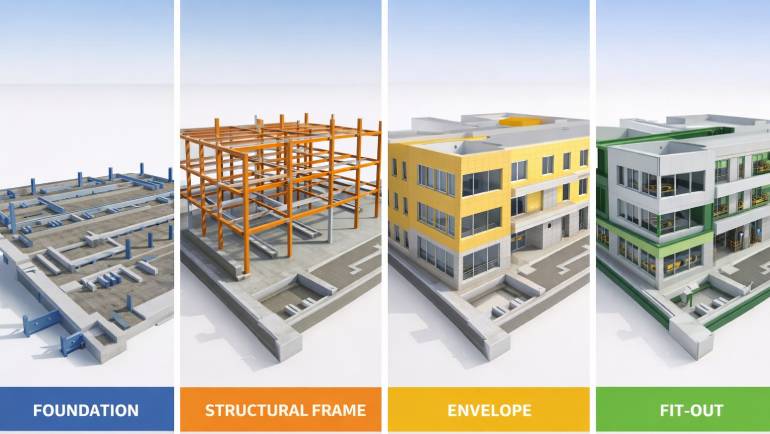
Most general contractors who have adopted BIM are using it at the Level 2 coordination stage, 3D modeling and clash detection. Far fewer are leveraging the full potential of 4D scheduling (linking the model to the project schedule) or 5D estimating (connecting model quantities to cost data). This leaves significant value unrealized.
4D BIM allows project teams to visualize construction sequences, identify schedule conflicts before they happen, and communicate phasing to owners and subcontractors in a format that is far more intuitive than a Gantt chart. 5D BIM connects model components to cost data, enabling live quantity takeoffs and budget tracking as the model evolves.
The Fix
Introduce 4D and 5D BIM capabilities incrementally. Start with 4D on projects where sequencing complexity is a known risk phased renovations, constrained site logistics, or accelerated schedules. Use the model linked schedule as a communication tool in owner meetings and OAC coordination calls.
For 5D, begin by using model derived quantities for one or two major scopes of work structural steel and concrete, for example, and compare them against traditional takeoff methods. The efficiency gains from model-based quantity takeoffs are typically substantial enough to justify broader adoption within one or two project cycles.
Addressing BIM Adoption Across the Trade Contractor Supply Chain
A GC’s BIM success is directly tied to the capabilities of their trade contractor network. This is why leading general contractors are increasingly investing in BIM adoption at the subcontractor level, either through training support, software access, or outsourced modeling services.
For trade contractors who are new to BIM, the most immediate barrier is often simply producing their first model. This is where outsourced BIM services including dedicated BIM for trade contractors provide the fastest path to compliance. A trade can have their design intent converted into a fully coordinated BIM model without requiring internal software investment or staff retraining.
According to Autodesk’s industry research, firms that adopt BIM consistently report measurable reductions in RFIs, change orders, and project delays. These benefits compound across the supply chain meaning GCs benefit most when their entire trade network participates.
A Practical BIM Adoption Roadmap for General Contractors
For GCs looking to move from BIM awareness to BIM execution, here is a realistic starting framework:
- Assess current state: Audit your last three to five projects. What BIM deliverables were required? How were they met? Where did coordination failures occur?
- Define a target BIM level: Not every project needs the same level of BIM maturity. Set a realistic target, typically Level 2 for most commercial GCs, and build toward it systematically.
- Build or buy BIM capability: Evaluate whether internal hiring, staff training, or outsourced BIM services is the right mix for your current project pipeline.
- Standardize your BEP template: Create a firm-level BIM Execution Plan template that is customized for each project, rather than starting from scratch each time.
- Embed BIM in contracts: Require BIM compliance from all trade contractors through explicit contract language, not verbal expectations.
- Measure and communicate ROI: Track RFI counts, change order costs, and schedule performance against pre-BIM baselines and share results internally to build organizational buy in.
Conclusion
BIM adoption is not a single decision, it is an ongoing organizational capability that general contractors must build deliberately. The challenges are real: cost, workforce skills, trade coordination, inconsistent subcontractor capability, and the complexity of running multi trade BIM workflows on live projects. But each of these challenges has practical, proven solutions.
The GCs gaining competitive advantage today are not the ones with the most sophisticated internal BIM infrastructure. They are the ones who have found the right combination of internal capability and outsourced support to deliver coordinated, model-based projects reliably and profitably regardless of what their subcontractor network brings to the table.
Whether you are just beginning your BIM journey or looking to expand from 3D coordination into 4D scheduling and 5D estimating, the path forward starts with an honest assessment of where your firm stands today and what it will take to meet the expectations of the projects you want to win tomorrow.
Learn how Mars BIM Solutions supports general contractors across the U.S. with comprehensive BIM services tailored to your project type and workflow.